
613
The global nanotechnology clothing market has entered a dynamic growth phase, driven by rapid technological advancements, evolving consumer preferences, and significant investments in smart and functional textiles. Characterized by the integration of nanomaterials into fabrics, nanotechnology-based clothing offers a compelling range of features—antimicrobial protection, water and stain resistance, UV shielding, improved durability, thermal regulation, and even real-time biometric sensing—without adding perceptible weight or bulk to the garments.
This article presents a detailed research-based assessment of the nanotechnology clothing market, exploring its current size, forecasted growth trajectory through 2029, segmentation, key trends, and strategic implications for industry stakeholders.
What Is Nanotechnology Clothing?
Nanotechnology clothing involves the application of nanoparticles, nanofibers, or nanocoatings to enhance textile properties at the molecular level. Typically ranging between 1–100 nm, these materials can be embedded into textile structures or applied as surface coatings. Their incorporation enables diverse functional improvements without compromising the comfort, flexibility, or aesthetics of fabrics.
Notable enhancements include:
Antimicrobial and anti-odor properties
Stain, water, and UV resistance
Enhanced breathability and thermal insulation
Reduced wrinkling and static
Biometric sensing and energy harvesting capabilities
Nanotechnology Clothing Market Size and Growth Forecast (2025–2029)
The market for nanotechnology-integrated apparel is experiencing exponential growth. According to industry projections:
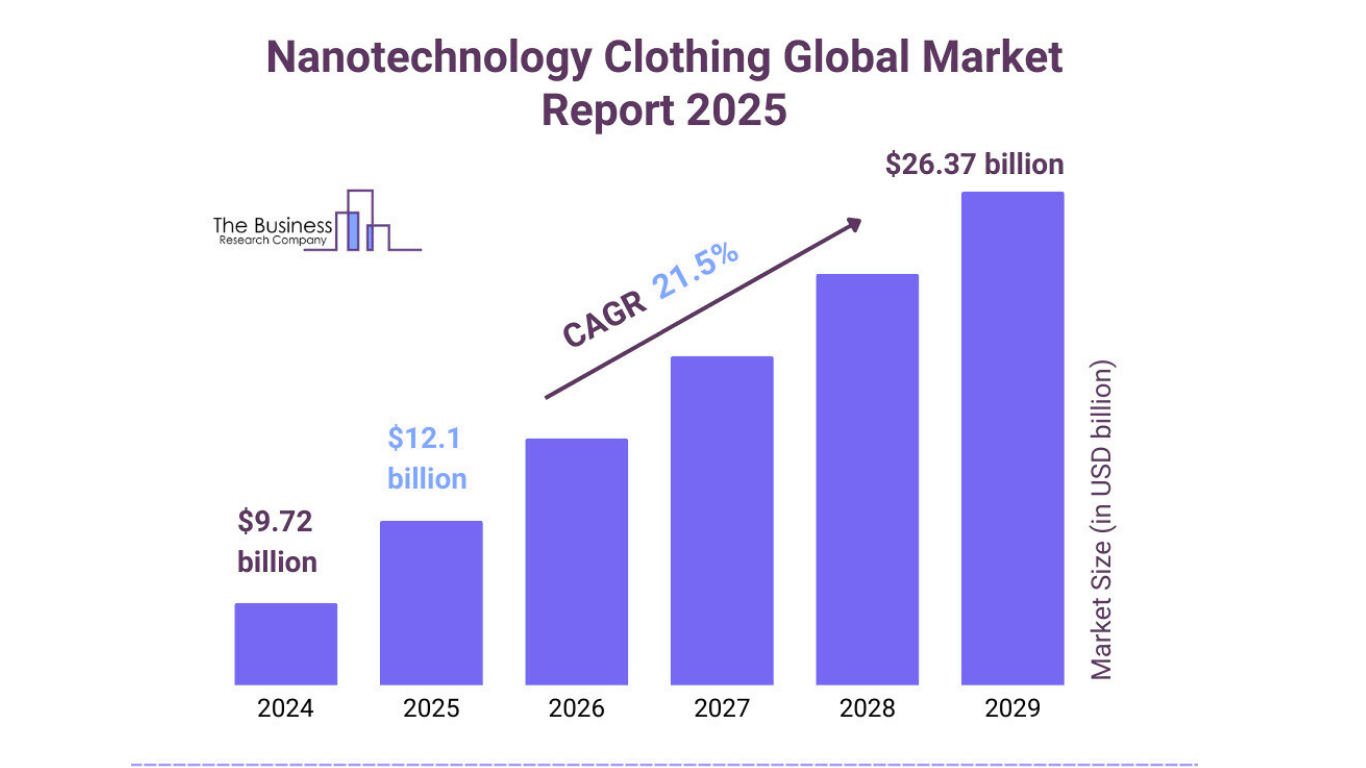
In 2024, the market was valued at $9.72 billion.
By 2025, it is forecasted to reach $12.1 billion, growing at a 24.6% CAGR.
By 2029, the market is expected to attain $26.37 billion, advancing at a compound annual growth rate (CAGR) of 21.5% over the forecast period.
This surge is underpinned by performance-driven consumer demand, expanding healthcare applications, and increased adoption of smart wearable technologies.
Segmentation of the Nanotechnology Clothing Market
According to an in-depth market report by The Business Research Company, the nanotechnology clothing market can be segmented across several dimensions:
By Type
Nanocoated Textiles: Includes antimicrobial coatings, water-repellent layers, and stain-resistant finishes.
Nanoporous Textiles: Employed for breathable, moisture-wicking, and membrane-based fabrics.
Fabrics with Nanofiber Webs: Used in nonwoven applications, offering lightweight and high-strength options.
Composite Fibers with Nanostructures: Includes fibers reinforced with carbon nanotubes, nanocomposites, and embedded nanoparticles.
By Application
Healthcare
Packaging
Sports and Leisure
Defense and Tactical Gear
Home and Household Textiles
Environmental Protection
Geotextiles
Others
By End-User Demographics
Men
Women
Children
Market Drivers
1. Medical Applications and Antimicrobial Fabrics
The incorporation of antimicrobial nanomaterials is significantly advancing textile applications in the healthcare sector. For example, Kraig Biocraft Laboratories’ BAM-1 spider silk hybrid, launched in 2024, exemplifies this trend with its antimicrobial, hypoallergenic, and biodegradable properties. These innovations support safer, sustainable, and protective clothing in hospital environments, surgical apparel, and patient wear.
2. Consumer Demand for Health and Wellness
A growing global consciousness surrounding health, hygiene, and wellness is reshaping consumer preferences. Nanotechnology-enabled clothing aligns with these values by offering self-cleaning, anti-odor, and UV-protective garments that actively support an active and healthy lifestyle.
Market Trends
1. Integration of Wearable Technology
A defining trend in the nanotechnology clothing landscape is the convergence with wearable electronics. Innovations such as nano-printing, as developed by South Korean researchers in 2024, enable the embedding of electronic functionalities directly into textile fibers. This eliminates bulky attachments and enhances both aesthetics and comfort, leading to a new era of smart clothing.
2. Programmable and Smart Fabrics
Research teams at institutions such as MIT are leading the development of programmable fiber technologies, enabling textiles to interact dynamically with their environment or user physiology. These fabrics can respond to heat, motion, and other stimuli, heralding a future where garments become responsive, adaptive systems.
3. Eco-Friendly and Biodegradable Nanomaterials
Environmental sustainability is becoming a cornerstone of innovation. Biodegradable nanomaterials, renewable polymers, and recyclable composite fibers are emerging as integral components of next-generation functional clothing, aligning with global ESG mandates and consumer values.
Key Players in the Global Market
Leading companies operating within the nanotechnology clothing sector include:
BASF SE
Toray Industries Inc.
Teijin Frontier Co. Ltd.
Patagonia Inc.
Nano Textile Ltd.
Spiber Inc.
Kraig Biocraft Laboratories
Helly Hansen AS
Osmotex AG
Bolt Threads Inc.
Nantero Inc.
NuMat Technologies Inc.
Nanotex LLC
NanoHorizons Inc.
These organizations are investing in R&D to develop advanced smart textiles, antimicrobial solutions, and sustainable nanocomposites for industrial-scale production.
Strategic Outlook and Conclusion
The nanotechnology clothing market represents a transformative confluence of advanced materials science, consumer-centric design, and digital integration. With increasing adoption across medical, defense, sports, and fashion sectors, this market is poised to redefine the functionality of clothing in the 21st century.
As stakeholders pursue sustainability goals, personalization trends, and health-aware lifestyles, nanotechnology textiles will play a pivotal role in addressing these demands. Furthermore, collaborations between textile engineers, material scientists, and digital technologists will accelerate the development of programmable, intelligent garments with cross-sectoral applications.
To remain competitive, industry participants must focus on:
Accelerating innovation in nano-enabled smart wearables
Ensuring regulatory compliance and eco-certifications
Expanding partnerships with research institutions and technology firms
Enhancing supply chain scalability and material sourcing resilience
Reference:
The data and market insights presented in this article are adapted from the comprehensive industry analysis provided by The Business Research Company – Nanotechnology Clothing Global Market Report.
You Might Be Interested In
- IBM Debuts World’s First Sub-1 Nanometer Chip Technology with Revolutionary Nanostack Architecture
- The Complete Guide to Nanotechnology and Nanoscience Education: Top Colleges, Costs, Careers, and Specializations
- Nanotechnology in Everyday Life: Current and Future Nanoproducts
- Apeiron Intelligence | New ICN2 Spin-Off Transforming Advanced Materials Design