
274
The Density of States (DOS) is one of the most fundamental concepts in solid-state physics, semiconductor science, and nanotechnology. It describes the number of electronic states available within a given energy interval that can be occupied by electrons. Since the distribution of electrons among these available states determines the electronic structure of a material, the DOS directly influences its electrical conductivity, optical absorption, thermal properties, magnetic behavior, and superconducting characteristics.
When the dimensions of a material are reduced to the nanoscale, the motion of electrons becomes increasingly restricted due to quantum confinement. This confinement modifies the electronic energy spectrum, leading to profound changes in the density of states. As a result, low-dimensional systems exhibit electronic properties that differ significantly from those of their bulk counterparts, providing opportunities to engineer materials with tailored functionalities for advanced electronic, photonic, and quantum technologies.
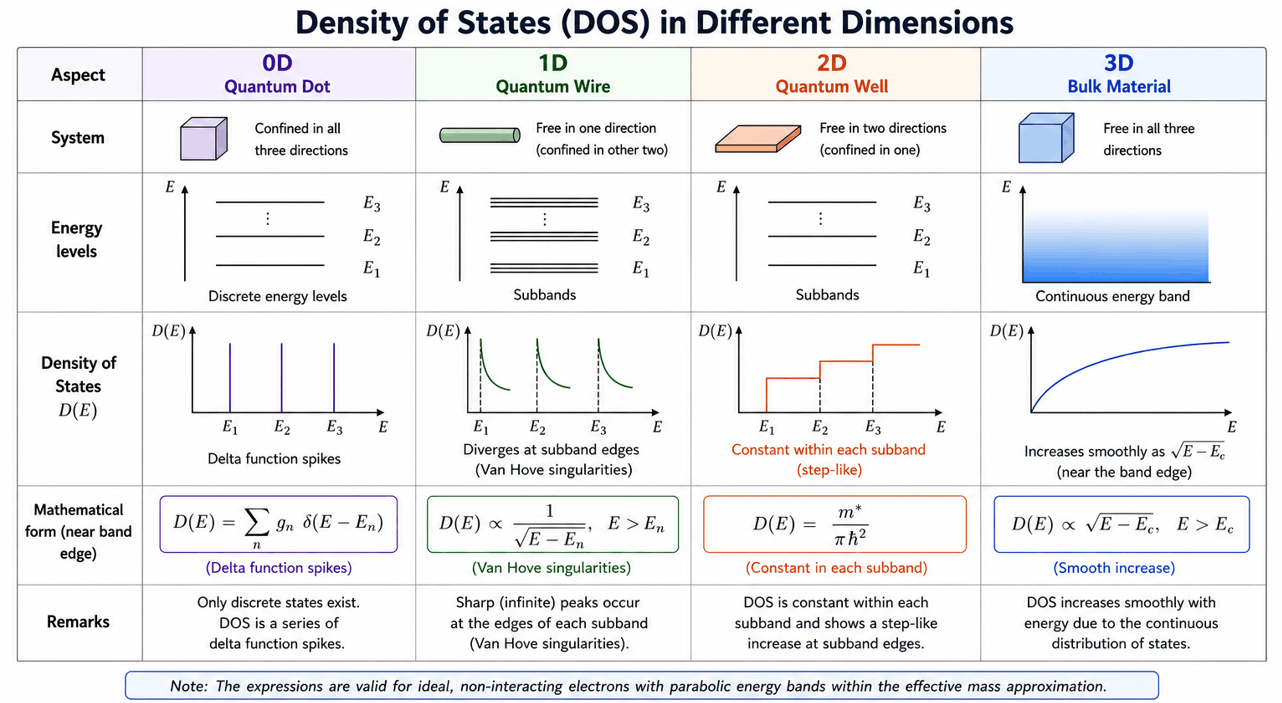
The accompanying figure illustrates the characteristic evolution of the density of states as dimensionality decreases from three-dimensional (3D) bulk materials to two-dimensional (2D) quantum wells, one-dimensional (1D) quantum wires, and zero-dimensional (0D) quantum dots.
Zero-Dimensional (0D) Systems – Quantum Dots
In quantum dots, charge carriers are confined in all three spatial dimensions, resulting in complete quantization of their energy levels. Consequently, the electronic spectrum consists of discrete energy states rather than continuous energy bands. This atomic-like electronic structure gives rise to unique optical and electronic properties, including size-dependent emission, narrow spectral linewidths, enhanced carrier confinement, and high photoluminescence efficiency. These characteristics have established quantum dots as key materials for applications in displays, light-emitting diodes, biomedical imaging, photodetectors, and quantum information science.
One-Dimensional (1D) Systems – Quantum Wires
Quantum wires confine charge carriers in two spatial dimensions while allowing free motion along one direction. This partial confinement leads to the formation of quantized energy subbands. Near the onset of each subband, the density of states exhibits pronounced peaks known as Van Hove singularities. These singularities strongly influence carrier transport, optical transitions, tunneling phenomena, and electron scattering, making one-dimensional nanostructures attractive for nanoscale electronics, sensors, and quantum transport devices.
Two-Dimensional (2D) Systems – Quantum Wells
In quantum wells, electrons are confined in one dimension while remaining free to move within a two-dimensional plane. The density of states is characterized by a step-like distribution, remaining constant within each quantized subband and increasing abruptly when higher-energy subbands become accessible. This behavior forms the basis of two-dimensional electron gases (2DEGs) and is fundamental to the operation of semiconductor heterostructures, high-electron-mobility transistors (HEMTs), quantum cascade lasers, and numerous optoelectronic devices.
Three-Dimensional (3D) Systems – Bulk Materials
In bulk crystalline materials, electrons are free to move in all three spatial dimensions, producing continuous energy bands. Accordingly, the density of states varies smoothly with energy, reflecting the large number of available momentum states in three-dimensional reciprocal space. This continuous distribution governs many fundamental properties of conventional semiconductors, metals, and superconductors, including carrier concentration, electrical conductivity, heat capacity, optical response, and magnetic susceptibility.
Importance of the Density of States
The density of states provides the fundamental connection between the electronic band structure and the observable physical properties of materials. By modifying dimensionality through nanoscale engineering, researchers can tailor the electronic structure to optimize charge transport, light–matter interactions, thermal transport, and quantum phenomena.
Engineering the density of states has therefore become a powerful strategy in the development of next-generation technologies, including nanoelectronics, optoelectronics, photovoltaics, spintronics, thermoelectric devices, superconducting materials, and quantum information systems.
Although real materials may exhibit additional complexities arising from electron-electron interactions, lattice defects, crystal anisotropy, strain, spin-orbit coupling, and non-parabolic energy bands, the trends illustrated in the accompanying figure accurately represent the ideal behavior predicted by the effective-mass approximation for low-dimensional semiconductor systems. These concepts form the foundation of modern condensed matter physics and nanoscience and remain essential for understanding the physics of quantum-confined materials.
Recommended References
- S. M. Sze and K. K. Ng, Physics of Semiconductor Devices, 3rd Edition, John Wiley & Sons, 2007.
- Charles Kittel, Introduction to Solid State Physics, 8th Edition, John Wiley & Sons, 2005.
- Neil W. Ashcroft and N. David Mermin, Solid State Physics, Holt, Rinehart and Winston, 1976.
- C. R. Kittel, Quantum Theory of Solids, John Wiley & Sons, 1987.
- S. Datta, Electronic Transport in Mesoscopic Systems, Cambridge University Press, 1995.
- Y. Imry, Introduction to Mesoscopic Physics, 2nd Edition, Oxford University Press, 2002.
- David Ferry and Stephen Goodnick, Transport in Nanostructures, 2nd Edition, Cambridge University Press, 2009.
- Peter Y. Yu and Manuel Cardona, Fundamentals of Semiconductors: Physics and Materials Properties, 4th Edition, Springer, 2010.
- C. Weisbuch and B. Vinter, Quantum Semiconductor Structures: Fundamentals and Applications, Academic Press, 1991.
- L. E. Brus, “Quantum Crystallites and Nonlinear Optics,” Applied Physics A, 53, 465–474 (1991), which discusses the emergence of discrete electronic states in semiconductor quantum dots.
Table of Contents
previous post