
324
Table of Contents
In a major leap for gas-sensing technology, researchers from IMDEA Nanociencia and Università Cattolica del Sacro Cuore have introduced a pioneering class of MINT-functionalized carbon nanotube sensors, capable of detecting volatile gases with unparalleled precision. Their work, published in the Journal of the American Chemical Society, unveils a groundbreaking “electronic nose” that blends sensitivity, selectivity, and low-power operation—all at room temperature.
📰 Read more: A breath of fresh tech—carbon nanotube sensors sniff out gases with unprecedented precision on Phys.org
Traditional carbon nanotube sensors have always promised high sensitivity due to their enormous surface area. But they have one flaw—poor selectivity, meaning they often fail to distinguish between different gases in mixed environments.
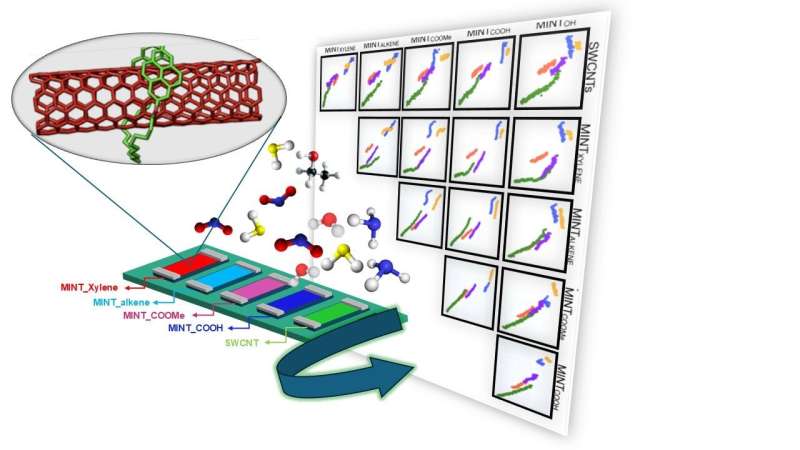
To overcome this, the researchers dressed the carbon nanotubes with specially designed ring-shaped molecules. These molecules are threaded around the nanotubes without altering their structure, creating MINTs (Mechanically Interlocked Carbon Nanotubes). The result: sensors that are both highly sensitive and chemically selective.
“The key was to create a functional structure that didn’t interfere with the carbon nanotube’s intrinsic properties,” said Dr. Michele Galvani, lead author of the study.
Tested against a wide range of gases—including ammonia (NH₃), nitrogen dioxide (NO₂), ethanol, benzene, acetone, and isopropanol—the MINT-enhanced sensors delivered reliable readings even at parts-per-billion (ppb) concentrations.
Highlights from the study:
>10× sensitivity boost compared to unmodified nanotubes
Faster response times with thinner sensor films
Selective detection in mixed-gas environments
Low-power operation at room temperature
In one striking demonstration, the sensor array was able to accurately distinguish ammonia in the presence of other potentially interfering vapors—something previous systems often struggled with.
This proof-of-concept system works much like a biological olfactory system, using a sensor array to decode complex gas mixtures. Because MINTs can be custom-designed, researchers now have fine control over how each sensor layer responds to specific molecules.
“By tuning the molecular architecture of the MINTs, we can tailor sensors for specific environments—from environmental monitoring to medical diagnostics,” the team reported.
Such customizability opens doors to scalable production of wearable breath analyzers, air quality sensors, and industrial leak detectors, all running on minimal power and offering real-time data.
Title: Efficient Implementation of MINT-Based Chemiresistor Arrays for Artificial Olfaction
Authors: Michele Galvani et al.
Published in: Journal of the American Chemical Society (2025)
Image credit: Emilio Pérez | Gas sensor based on MINT-functionalised carbon nanotubes
This breakthrough in nanomaterials and molecular engineering marks a pivotal moment for artificial olfaction. With scalable design and unmatched precision, MINT-based carbon nanotube sensors are poised to reshape how we monitor gases—from our cities to our breath.