
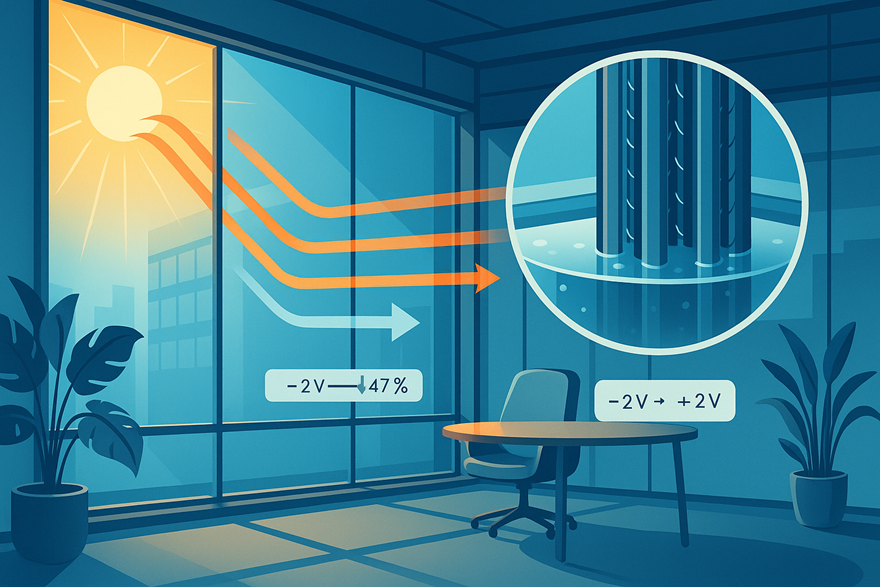
Researchers have developed a novel smart window technology that leverages vertically aligned carbon nanotube (VACNT) films to selectively dim near-infrared (NIR) light, a significant component of solar heat. This innovative approach promises to create a new generation of windows that can dynamically control heat gain without noticeably darkening the interior of a building.
How the Technology Works
The key to this selective tinting effect is the precise alignment of the nanotubes. When normally incident light hits the film, light polarized perpendicular to the nanotubes’ orientation activates a doping-induced intersubband plasmon. This plasmon then absorbs light in the NIR spectrum, causing the tinting effect. By applying a small voltage to the device, researchers can control the doping level of the nanotubes and, in turn, their absorption properties, effectively switching the “tint” on or off.
The films are meticulously engineered to be over 98% single-wall carbon nanotubes, with a diameter of approximately 2.6 ± 0.7 nm. Their high degree of alignment, within about ±6°, is critical for the selective absorption mechanism. Despite an approximate thickness of just 0.8 μm, the films can still achieve more than 50% visible light transmittance, ensuring the window remains clear to the human eye.
Performance and Practical Considerations
The researchers tested two different contact materials to evaluate the device’s performance:
- Platinum (Pt) Contacts: This configuration provides a faster response, with switching speeds of roughly 6 seconds to turn on and 1 second to turn off. The safe operating voltage for this setup is limited to approximately -1 V to +1 V. It showed a 24% change in NIR transmittance near 0.68 eV.
- Titanium Nitride (TiN) Contacts: While this material has a wider safe voltage window of -2 V to +2 V, the device’s switching speed is slower due to TiN’s higher sheet resistance. However, it demonstrated a superior performance, with up to a 47% change in NIR transmittance at about 0.83 eV.
Both configurations showed impressive open-circuit retention, with the device maintaining its “on” state for more than 100 seconds after the voltage was removed.
These results highlight the potential for practical, NIR-only tinting. By reducing solar heat gain without compromising on natural daylight, this technology could lead to significant energy savings for heating and cooling in residential and commercial buildings. It represents a major step forward in the development of materials for sustainable architecture.
Reference: [1] Abelson, A., et al. “Exploiting Intersubband Plasmons in Vertically Aligned Carbon Nanotubes for Near-Infrared Electrochromic Windows.” Nano Letters, 2025, 25, 11762–11767. Official Link to the Paper
Table of Contents