
429
Introduction
In a pioneering advancement in quantum physics, researchers at the Massachusetts Institute of Technology (MIT) have achieved the first-ever direct imaging of individual atoms freely interacting in real space. Published in Physical Review Letters on May 5, 2025, the findings offer a tangible view of quantum correlations that until now had remained abstract mathematical constructs. This breakthrough sheds unprecedented light on quantum behaviors such as bosonic bunching and fermionic pair formation—phenomena that form the foundational underpinnings of superconductivity and other emergent quantum states of matter.
Methodological Innovation: Atom-Resolved Microscopy
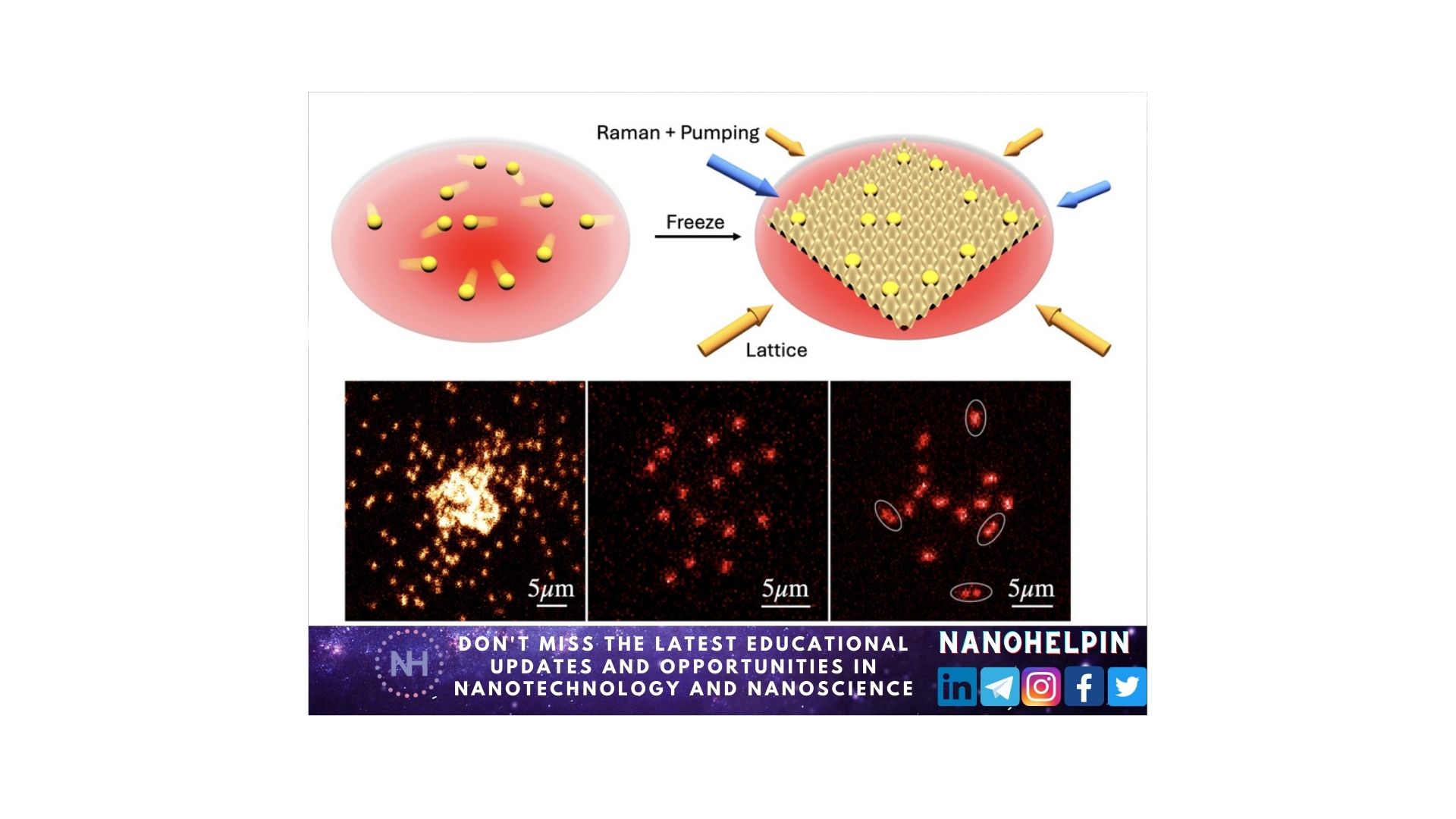
Traditional imaging methods such as absorption imaging provide only ensemble-level data about atomic clouds. In contrast, the MIT team, led by Professor Martin Zwierlein and Assistant Professor Richard Fletcher, developed a technique called atom-resolved microscopy, which freezes ultracold atomic clouds using an optical lattice and then images them through Raman sideband cooling. This methodology allows researchers to observe quantum particles in situ, with single-atom resolution.
The technique operates by allowing atoms to interact in a loosely confined optical trap. At a chosen moment, a lattice of light is pulsed to freeze the atoms’ positions. Then, a finely tuned laser is used to illuminate the trapped particles, whose fluorescence reveals their precise location. Importantly, this is achieved without perturbing their delicate quantum states—a challenge likened by the researchers to “not boiling the atoms out of the optical lattice.”
Quantum Behaviors Visualized: Boson Bunching and Fermion Pairing
Bosonic Bunching and the de Broglie Wave
The researchers first applied their technique to bosons, specifically ultracold sodium atoms that form a Bose-Einstein condensate (BEC) at low temperatures. BECs, long predicted by Einstein and Bose and first realized by MIT’s Nobel laureate Wolfgang Ketterle, represent a state where all bosons occupy the same quantum state.
The MIT team was able to directly visualize these atoms “bunching” together—an expected quantum behavior that reflects the shared wavefunction described by Louis de Broglie’s hypothesis. These visualizations offer the first empirical confirmation in real space of the bosonic tendency to correlate spatially due to their indistinguishable and additive wave nature.
“We can visualize this wave directly,” says Zwierlein. “That’s what makes this microscope so powerful.”
.
Fermionic Pair Formation: A Window into Superconductivity
Equally groundbreaking was the direct observation of fermion pairing. Fermions—particles such as electrons that obey the Pauli exclusion principle—typically repel each other. However, under certain conditions, especially at ultracold temperatures, different types of fermions can pair, a process central to superconductivity.
Using lithium atoms with differing spin states, the MIT researchers directly imaged these interactions, capturing the moment when two unlike fermions form quantum pairs. Previously understood only through indirect measurements or theoretical models, this pairing was visualized as discrete coupled particles within the atom cloud.
“It’s showing in a photograph an object that was discovered in the mathematical world,” says Fletcher, emphasizing the profound visual validation of long-standing quantum theory.
Context and Parallel Discoveries
Two other groups also published complementary results in the same issue of Physical Review Letters, utilizing similar imaging techniques. MIT’s Wolfgang Ketterle observed enhanced boson pair correlations, while Tarik Yefsah’s team at École Normale Supérieure visualized noninteracting fermions. These simultaneous studies reflect a growing paradigm shift in quantum gas microscopy, wherein spatially resolved images provide empirical evidence of previously inaccessible quantum interactions.
Future Implications
The successful imaging of bosonic and fermionic behaviors in situ opens new avenues for exploring quantum many-body systems, topological states of matter, and low-dimensional quantum materials. More broadly, the ability to directly observe quantum correlation and dynamics in real space will likely influence the design of next-generation quantum simulators and computing platforms.
“Physics is about physical things. It’s real,” says Fletcher, affirming the profound empirical impact of visualizing quantum phenomena once confined to theoretical abstractions.
Conclusion
This research not only marks a milestone in quantum imaging but also enhances our conceptual and experimental grasp of quantum mechanics. By rendering the invisible visible, the MIT team’s work bridges the divide between theory and observation, offering a powerful new lens on the quantum world.
News Source:
Chu, J. (2025, May 5). MIT physicists snap the first images of “free-range” atoms. MIT News. Retrieved from
https://news.mit.edu/2025/mit-physicists-snap-first-images-free-range-atoms-0505