
122
Introduction
A single, atom-thin crystal that can act like a mirror in one direction and like clear glass in another sounds like science fiction — yet that is exactly what researchers have now measured in molybdenum oxychloride (MoOCl₂). In a study published in Nano Letters, an international team reported the first complete experimental map of this layered crystal’s optical behaviour, revealing what they describe as the strongest light-bending effect ever recorded in a natural material.
The result is more than a laboratory curiosity. By pinning down the exact numbers that describe how MoOCl₂ interacts with light, the work hands engineers the design data they need to build a new generation of ultra-compact optics — from augmented-reality (AR) glasses and smart contact lenses to high-speed integrated photonic chips.
Background
The dream of “invisible” wearable electronics — displays you wear on your eye, or AR glasses indistinguishable from ordinary spectacles — runs into a stubborn problem: conventional lenses, polarizers, and waveguides are bulky. Shrinking them means finding materials that can manipulate light at the atomic scale rather than across millimetres of glass.
That search has increasingly turned to van der Waals materials — layered crystals, like graphene, whose atomic sheets are held together by weak van der Waals forces and can be peeled down to a few atoms thick. MoOCl₂ belongs to this family, and physicists had already taken an interest in it: earlier experiments published in Science and Nature Communications visualized tightly confined light waves, known as hyperbolic plasmon polaritons, travelling through the crystal in highly directional ways.
What was missing was rigour. Scientists could observe the exotic effects but had never directly measured the material’s full set of optical constants. Without those numbers, designing real devices around MoOCl₂ was guesswork. The new study closes that gap.
The Science Explained
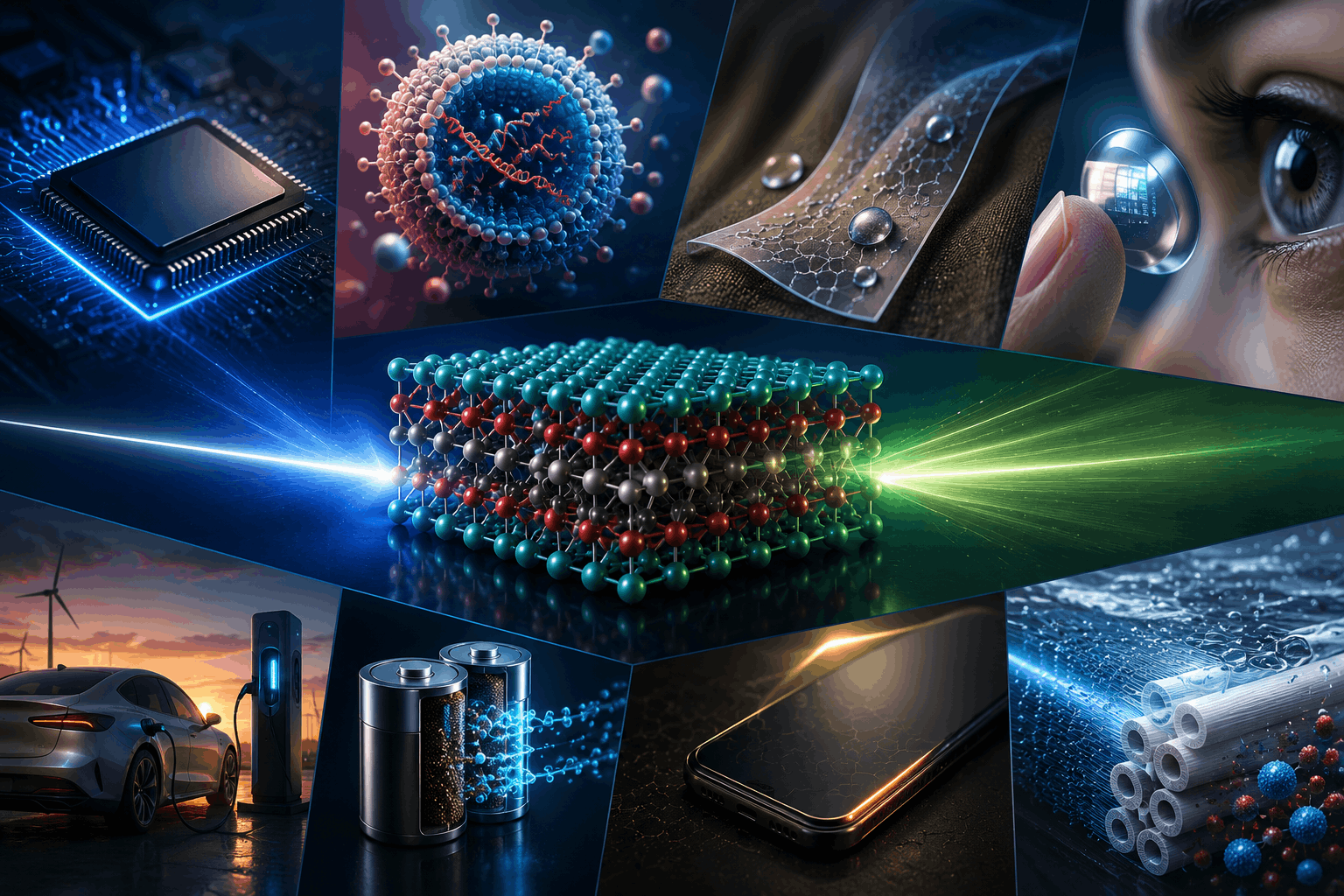
The headline property of MoOCl₂ is extreme optical anisotropy — its response to light depends dramatically on direction. Orient the crystal one way and it reflects light like a metal; rotate it by 90 degrees and it turns transparent like glass. The team calls it an optical “chameleon.”
This behaviour traces back to the crystal’s structure. MoOCl₂ is built from quasi-one-dimensional chains of molybdenum atoms and shows a strongly direction-dependent electronic response — often described informally as a “bad metal.” Along one crystal axis (the metallic a-axis) it reflects light like a metal; along the perpendicular axis (the dielectric b-axis) it transmits light like an insulator. That built-in contrast is what produces the enormous optical anisotropy. (More precisely, detailed studies attribute the effect to an orbital-selective Peierls distortion in the Mo–Mo chains, so the metallicity is both direction- and orbital-dependent rather than a simple free-electron metal.)
Two measured numbers stand out:
- In-plane birefringence of about 2.2. Birefringence is the difference in how strongly a material bends light along two directions. For comparison, well-known birefringent crystals such as calcite (~0.17) and rutile (~0.29) sit well below 0.3 — so a value of ~2.2 is in a different league. Independent measurements place MoOCl₂ above benchmark anisotropic crystals such as rutile, BaTiS₃ and NbOCl₂, making it a record specifically for low-loss optical anisotropy across the visible and near-infrared. (That qualifier matters: a few absorptive materials, such as MoS₂, reach Δn > 1.5 inside strongly absorbing bands, where they are far less useful for real optics.)
- A visible-frequency epsilon-near-zero (ENZ) point at 512 nm (green light). At this wavelength, one component of the crystal’s optical response drops almost to zero. When that happens, light effectively “slows,” the electric field inside the crystal intensifies, and electromagnetic energy is squeezed into a tiny volume — dramatically boosting light–matter interactions. Crucially, most materials only reach ENZ conditions in the deep ultraviolet or mid-infrared; MoOCl₂ does it in the visible band, where lasers, cameras, microscopes, and sensors already operate.
Because of its strong structural anisotropy, MoOCl₂ also acts as a natural hyperbolic medium, channelling light into highly directional nanoscale rays without the spreading (diffraction) that limits conventional optics.
“Observing a phenomenon is the first step, but engineering requires precise numbers,” said Dr. Valentyn Volkov, founder and CTO of XPANCEO and corresponding author of the study. “By rigorously measuring the complete dielectric tensor of MoOCl₂, our work provides the experimental foundation needed to understand why this material behaves the way it does and to design around it with greater confidence.”
Key Features at a Glance
- Optical “chameleon”: metallic reflection along one axis, glass-like transparency along the other.
- Record light-bending: in-plane birefringence of ~2.2, reported as the strongest measured in a natural material.
- Visible-light ENZ point at 512 nm: rare light-slowing, field-enhancing behaviour right where everyday optics operate.
- Natural hyperbolic medium: guides light in directional nanoscale beams without diffraction.
- Atomically thin: delivers complex light control using layers thousands of times thinner than a human hair.
- Fully characterised: the first direct measurement of the material’s complete dielectric tensor.
Applications
The researchers outline several near- and longer-term uses:
- Smart contact lenses and ultrathin AR glasses — atomic-scale optics that replace bulky lens stacks for “invisible” wearables.
- Integrated photonic chips — the visible ENZ effect supports faster data processing at lower power, where light must be routed, filtered, and concentrated in tiny spaces.
- Ultrathin broadband polarizers — compact components that control the direction of light.
- Sub-diffractional waveguides — channels that guide light through spaces smaller than conventional optics allow.
- Nonlinear nanophotonics — intense light–matter coupling to generate new colours of light or process optical signals more efficiently.
Advantages
What makes MoOCl₂ compelling is that a single, naturally layered crystal delivers light-control tricks that normally require carefully engineered metamaterials or thick optical assemblies. Its record anisotropy enables extreme miniaturisation; its visible-range ENZ point aligns with existing photonic technology; and as a van der Waals material it is, in principle, compatible with the thin-film, stack-and-transfer fabrication already used for graphene and other 2D materials. Having the full optical constants in hand also removes a major source of design uncertainty for engineers.
Challenges
Important caveats remain. The study is a materials-characterisation milestone, not a finished device — working AR displays or smart contact lenses built from MoOCl₂ are a longer-term prospect. Practical questions around large-area, high-quality crystal growth, environmental stability, integration with electronics, and manufacturing yield still need to be answered before the material reaches products. As with many 2D materials, moving from a pristine laboratory flake to a robust, scalable component is where much of the hard engineering lies.
Future Outlook
By converting a striking observation into hard design data, this work shifts MoOCl₂ from “interesting physics” toward “usable engineering material.” Expect follow-up research on device demonstrators — compact polarizers, on-chip waveguides, and nonlinear elements — as well as deeper exploration of other hyperbolic van der Waals crystals. If the manufacturing challenges can be tamed, anisotropic crystals like MoOCl₂ could become foundational building blocks for the ultra-compact optics that next-generation wearables and photonic processors will demand.
It is also worth noting who is behind the work: the author list includes Sir Konstantin (Kostya) Novoselov, the Nobel laureate co-discoverer of graphene — a reminder that the toolkit pioneered with graphene is now being turned on a far wider library of 2D materials.
References
- Ermolaev, G., Toksumakov, A., Slavich, A., Minnekhanov, A., Tselikov, G., Mazitov, A., Kruglov, I., Tikhonowski, G., Mironov, M., Radko, I. P., Grudinin, D., Fradkin, I., Vyshnevyy, A., Sofer, Z., Arsenin, A., Novoselov, K. S., & Volkov, V. “Giant Optical Anisotropy and Visible-Frequency Epsilon-near-Zero in Hyperbolic van der Waals MoOCl₂.” Nano Letters, 2026, 26(13), 4329. DOI: 10.1021/acs.nanolett.5c06153
- XPANCEO Research on Natural Science LLC. “Mirror or Glass: a crystal with two optical faces shows one of the strongest light-bending effects seen in a natural material.” EurekAlert!, 1 June 2026.
- “This strange crystal acts like metal and glass at the same time.” ScienceDaily, 1 June 2026.
- Prior MoOCl₂ studies on hyperbolic plasmon polaritons: Science (DOI: 10.1126/science.adr5926) and Nature Communications (DOI: 10.1038/s41467-024-53988-7).
Frequently Asked Questions (FAQ)
What is molybdenum oxychloride (MoOCl₂)? MoOCl₂ is a layered, van der Waals crystal made of molybdenum, oxygen, and chlorine. Its atoms form one-dimensional molybdenum chains that give it extreme optical anisotropy — meaning it interacts with light very differently depending on direction.
Why is MoOCl₂ being called record-breaking? Researchers measured an in-plane birefringence of about 2.2, which they report as the strongest light-bending effect ever recorded in a natural material. Common birefringent crystals like calcite and rutile are well below 0.3.
What is an epsilon-near-zero (ENZ) point, and why does 512 nm matter? At an ENZ point, a material’s optical response drops close to zero, slowing light and intensifying the internal electric field. MoOCl₂ reaches this state at 512 nm (green light) — within the visible band where most lasers, cameras, and sensors operate, unlike typical ENZ materials that work in the UV or infrared.
What could MoOCl₂ be used for? Potential uses include ultrathin AR glasses and smart contact lenses, integrated photonic chips, ultrathin polarizers, sub-diffractional waveguides, and nonlinear nanophotonic devices.
Is this a finished product? No. The study is a fundamental materials-characterisation result. Real devices will require advances in crystal growth, stability, and scalable manufacturing.
Table of Contents