
627
The advent of nanotechnology has ushered in a new frontier in science, with nanorobots—also known as nanobots or nano-scale robotic systems—emerging as transformative tools with far-reaching applications. Operating at the nanoscale (1–100 nanometers), these engineered molecular machines possess the potential to address some of the most complex challenges in biomedicine, environmental science, and molecular manufacturing.
Nanobots are being rigorously researched for their capabilities in targeted drug delivery, real-time diagnostics, tissue engineering, and non-invasive surgical interventions. Moreover, their integration into environmental remediation and smart material systems positions them at the convergence of disciplines such as biotechnology, materials science, robotics, and synthetic biology
Understanding Nanobots: Engineering Precision at the Nanoscale
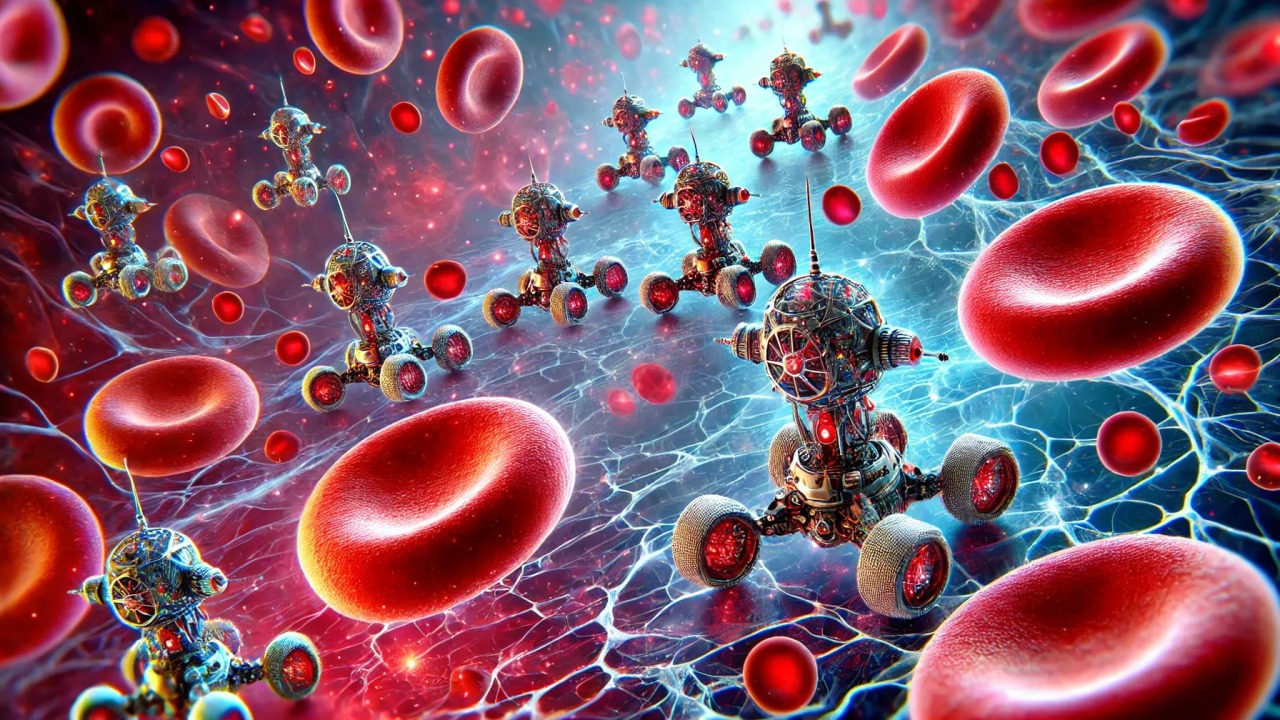
Nanorobots are nanoscale mechanical devices or synthetic constructs designed to perform programmable tasks at the molecular or cellular level. For perspective, their size is approximately 1,000 times smaller than a human hair strand. These nano-devices are typically composed of biocompatible materials, and some are fabricated using DNA origami, carbon nanotubes, gold nanoparticles, or magnetic nanomaterials.
They are engineered to:
Navigate biological systems (e.g., the bloodstream)
Recognize specific cellular markers
Deliver molecular payloads
Monitor physiological parameters
Perform micro-scale repairs or surgery
Biomedical Applications of Nanobots: Precision Therapeutics and Diagnostics
1. Targeted Drug Delivery Systems
One of the most promising applications of nanobots lies in site-specific drug delivery, particularly in oncology. Conventional chemotherapy indiscriminately affects both malignant and healthy cells, leading to systemic toxicity. Nanobots can be programmed to recognize specific biomarkers—such as surface antigens or pH levels—thereby enabling spatially localized drug release at the pathological site (e.g., tumors), while preserving adjacent healthy tissues.
Keywords: targeted drug delivery, smart therapeutics, nanoparticle drug carriers, precision medicine, cancer nanotechnology
2. Cancer Treatment via Photothermal and Chemo-Nano Therapies
Gold-coated nanobots and thermally responsive nanomaterials are increasingly used in photothermal therapy (PTT), wherein external stimuli such as near-infrared light or ultrasound activate the nanobot’s payload, leading to localized tumor cell destruction. This technique significantly reduces recurrence rates and supports personalized oncology protocols.
Keywords: cancer nanomedicine, photothermal nanobots, nano-oncology, tumor-targeting nanocarriers
3. Cellular-Level Surgeries and Tissue Regeneration
Nanobots are being developed to perform microscale surgical interventions—such as thrombus removal, neural repair, or cartilage reconstruction. Using biodegradable polymers and stimuli-responsive hydrogels, these agents can assist in tissue engineering and regenerative medicine, offering minimally invasive solutions for otherwise high-risk surgeries.
Keywords: nanorobotic surgery, tissue regeneration, neural repair nanotechnology, biocompatible nanobots
4. Real-Time Health Monitoring and Biosensing
Implantable or circulatory nanobots are envisioned to act as real-time biosensors, continuously tracking biological markers (e.g., glucose, cholesterol, lactate, cytokines). These diagnostic systems may interface with wearable devices or mobile health platforms, revolutionizing the monitoring of chronic diseases such as diabetes or cardiovascular disorders.
Keywords: biosensing nanobots, continuous health monitoring, wearable nanotechnology, personalized diagnostics
Beyond Healthcare: Cross-Disciplinary Applications of Nanobots
1. Environmental Nanobots for Pollution Control
Nanobots can actively detect and neutralize environmental pollutants. They are engineered with catalytic or adsorptive surfaces to sequester and break down organic toxins, heavy metals, or microplastics in water and soil systems. This molecular-level clean-up can augment existing environmental technologies in waste management and sustainability.
2. Precision Nanomanufacturing
Nanobots can act as autonomous assembly units, enabling molecular manufacturing through bottom-up fabrication. They have the potential to construct functional materials and devices atom-by-atom or molecule-by-molecule, offering new capabilities in semiconductor fabrication, pharmaceutical synthesis, and nanoelectronics.
3. Smart Materials and Adaptive Devices
Integrating nanobots into textiles, coatings, or structural materials enables the development of smart surfaces capable of self-healing, adaptive behavior, or biometric sensing. Such technologies are anticipated to find use in wearable health tech, aerospace, and defense systems.
Key Challenges and Research Frontiers
Despite significant breakthroughs, several barriers hinder the clinical and industrial translation of nanobot technologies:
Biocompatibility and Safety: Ensuring immunological acceptance and non-toxicity in vivo remains a crucial area of study.
Energy and Control Systems: Developing scalable and remote-controlled powering mechanisms, including magnetic, acoustic, and light-based navigation.
Mass Fabrication: Standardizing cost-effective, high-throughput manufacturing processes using nanolithography, 3D nano-printing, or molecular self-assembly.
Ethical and Regulatory Frameworks: Establishing clear policies for nanobot use in medicine and the environment.
Ongoing research is focusing on biohybrid nanorobots, AI-driven swarm control algorithms, and nano-bio interfaces for improved functionality and control.
Conclusion: Toward a Nano-Enabled Future
Nanorobots represent a paradigm shift in how we conceive of machines and their role in biology, industry, and ecology. With their ability to operate autonomously at the nanoscale, nanobots are poised to become a cornerstone of precision medicine, smart manufacturing, and sustainable technologies. As interdisciplinary collaborations and AI-guided design accelerate development, the transition from laboratory concept to real-world deployment is imminent.
This nano revolution underscores a fundamental shift: from treating diseases to engineering biological systems at the molecular level, from remediating pollution to designing self-evolving smart devices. The age of intelligent, molecular-scale machines is not on the horizon—it is already here
You Might Be Interested In
- Purdue Advances in 2D Nanomaterials for Extreme Environments
- Nanotechnologies: Principles, Applications, Implications and Hands on Activities
- In Vivo 3D Printing with Ultrasound: A Breakthrough in Deep Tissue Drug Delivery and Biopolymer Fabrication
- The Invisible Revolution Diving into Nanoscience and Nanotechnology