
1.4K
Explore the Best Free Courses in Nanoscience and Nanotechnology! 🧪🔬
Are you eager to dive into the fascinating world of nanoscience and nanotechnology? Whether you’re a student, a professional, or a curious learner, these top free online courses from leading universities and platforms will help you build a solid foundation, enhance your skills, and boost your CV for future studies or global job opportunities. Below, find detailed descriptions of each recommended course, so you can choose the best fit for your learning journey.
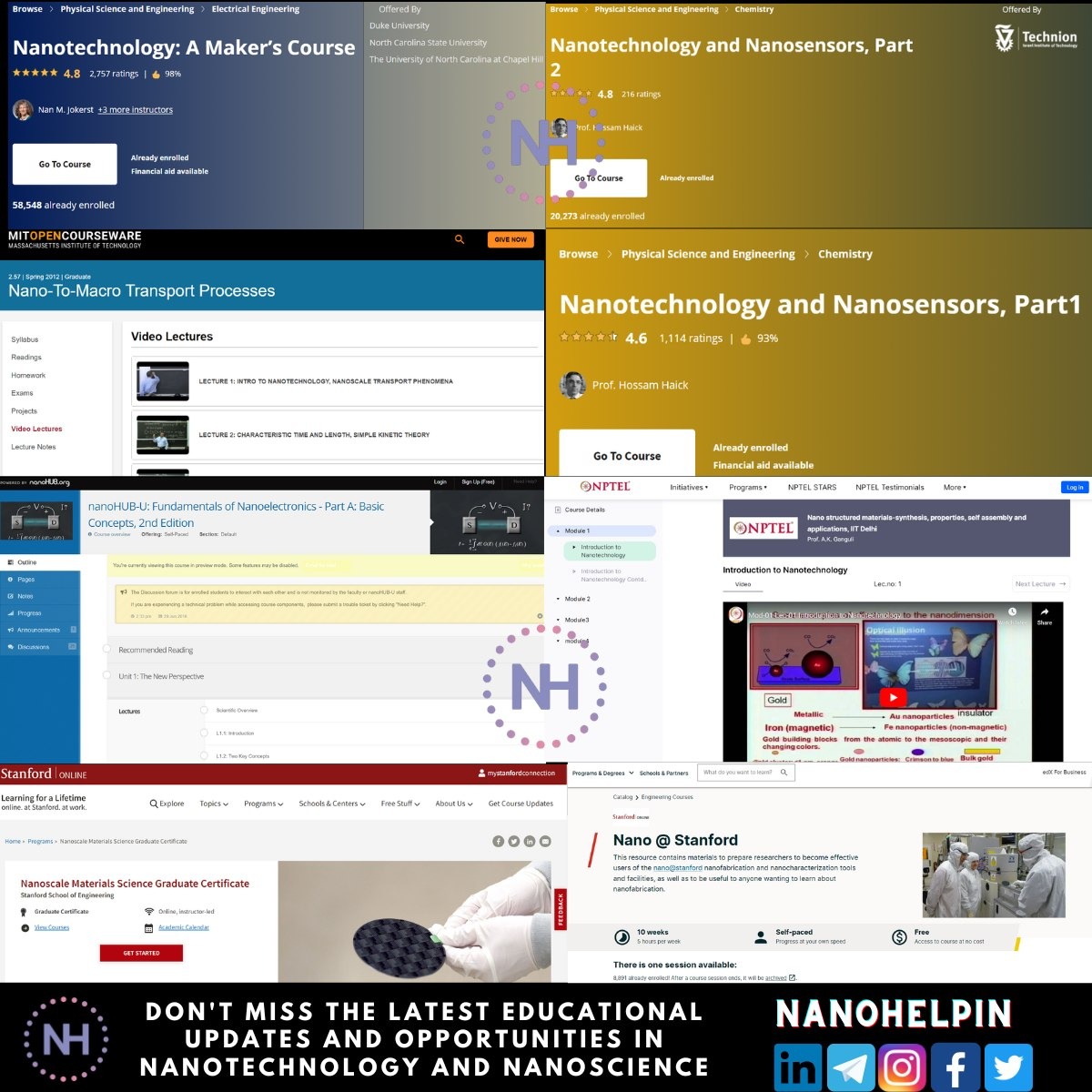
1️⃣ Nanotechnology: A Maker’s Course
Platform: Coursera
Link: Nanotechnology: A Maker’s Course
This course, developed by Duke University, introduces you to the practical side of nanotechnology through hands-on demonstrations and lab instruction. You’ll gain a strong understanding of nanofabrication and characterization tools, learning how to create and analyze structures at the nanoscale. The course bridges theory and practice, making it ideal for those who want to see how nanotechnology is applied in real-world scenarios.
2️⃣ Nano @ Stanford
Platform: edX
Link: Nano @ Stanford
Nano @ Stanford is designed to prepare researchers and students to use advanced nanofabrication and nanocharacterization tools. It covers essential concepts and provides in-depth training on the use of Stanford’s state-of-the-art facilities. The course is also valuable for anyone interested in learning about nanofabrication, regardless of institutional affiliation.
3️⃣ Nanotechnology and Nanosensors, Part 1
Platform: Coursera
Link: Nanotechnology and Nanosensors, Part 1
Offered by Technion – Israel Institute of Technology, this course explores the fundamental principles of nanotechnology and nanosensors. You’ll learn about the design, fabrication, and application of nanosensors, as well as their impact on modern technology. The course encourages creative problem-solving through multicultural group projects and real-world challenges, making it highly interactive and practical.
4️⃣ Nanotechnology and Nano sensors, Part 2
Platform: Coursera
Link: Nanotechnology and Nanosensors, Part 2
A continuation of Part 1, this course delves deeper into advanced nanosensor technologies and their applications. You’ll explore case studies, emerging trends, and the latest research in nanosensors, preparing you for further study or a career in this rapidly evolving field.
5️⃣ Nano-To-Macro Transport Processes
Platform: MIT OpenCourseWare
Link: Nano-To-Macro Transport Processes
This self-paced course from MIT examines how energy and heat move from the nanoscale to the macroscale. You’ll study photons, electrons, phonons, and molecules as energy carriers, gaining a fundamental understanding of transport phenomena. The course is packed with practical examples, making it ideal for those interested in the physics and engineering of nanomaterials.
6️⃣ nano HUB-U: Fundamentals of Nanoelectronics - Part A: Basic Concepts, 2nd Edition
Platform: nanoHUB
Link: Fundamentals of Nanoelectronics – Part A
This course introduces the quantum mechanics behind nano electronic devices. You’ll learn about the basic concepts of nanoelectronics, including the behavior of electrons at the nanoscale and how these principles are used to design modern electronic devices. The course includes simulation tools and practical exercises, making complex concepts accessible.
7️⃣ Nanostructured Materials: Synthesis, Properties, Self-Assembly, and Applications (IIT Delhi)
Platform: NPTEL
Link: Nanostructured Materials
Offered by IIT Delhi through NPTEL, this course covers the synthesis, properties, and self-assembly of nanostructured materials. You’ll explore how these materials are engineered for use in electronics, medicine, energy, and more. The course includes detailed explanations, real-world examples, and laboratory demonstrations to help you understand the transformative potential of nanomaterials.
8️⃣ Nanoscale Materials Science Graduate Certificate
Platform: Stanford Online
Link: Nanoscale Materials Science Graduate Certificate
This advanced program is designed for those seeking a deeper understanding of nanoscale materials science. You’ll study advanced topics in nanotechnology research, including the latest developments in nanomaterials and their applications. Completing this certificate can significantly enhance your credentials for research or academic careers.
Why Choose Free Online Nanotechnology Courses?
- Learn from Top Universities: Courses are offered by institutions like Stanford, MIT, IIT Delhi, and Technion.
Flexible and Accessible: Study at your own pace, from anywhere in the world.
Career Advancement: Gain skills and certificates that strengthen your CV and open doors to research, industry, or further study.
Cutting-Edge Content: Stay updated with the latest trends, applications, and research in nanoscience and nanotechnology.
How to Get Started
- Click the course links above to visit the official course pages.
- Enroll for free and start learning immediately.
- Complete assignments and projects to earn certificates (where available).
- Add your new skills and certificates to your CV and LinkedIn profile.
My opinion
Don’t miss out on these exceptional opportunities to expand your knowledge and skills in nanoscience and nanotechnology. Whether you’re preparing for higher education, a research career, or simply want to satisfy your curiosity, these free courses are your gateway to one of the most exciting fields in science and engineering.
Note: All course links direct you to the official platforms. Always verify course details and availability before enrolling.
You Might Be Interested In
- Advancing Refractory Ceramics: Microstructure-Driven Thermal Shock Resistance in THEFRAMIC Project
- India’s Top 20 Nanotechnology Research Centres & Labs:
- Top 10 Nanotechnology Institutes in the World: Leading the Future of Nano-Innovation
- DST Nano‑Mission National Postdoctoral Fellowship in Nano Science & Technology