
15
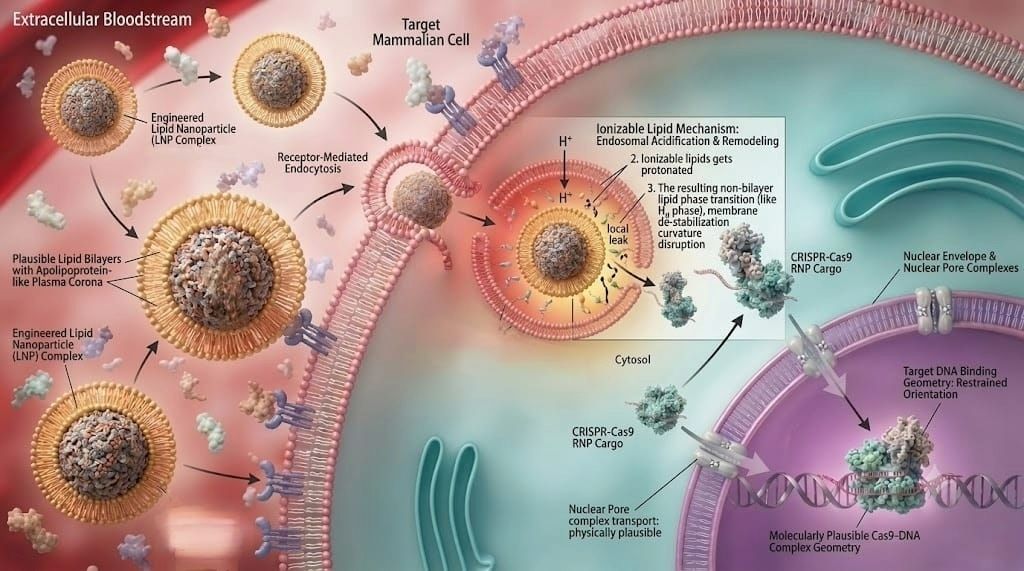
The clinical translation of targeted gene-editing therapeutics hinges on overcoming intracellular delivery barriers to transport macromolecular machinery intact to the host genome. Lipid nanoparticles (LNPs) represent the premier non-viral vector class for packaging and systemic transit of CRISPR-Cas9 ribonucleoprotein (RNP) complexes, mitigating off-target persistence associated with viral transduction while preserving enzymatic fidelity. Following systemic circulation, dynamic apolipoprotein corona assembly directs LNPs toward target mammalian cells to drive receptor-mediated endocytosis. Within the maturing endosome, differential acidification triggers the protonation of ionizable tertiary amine lipids, driving membrane destabilization via non-bilayer hexagonal phase transitions to facilitate cytosolic translocation of the intact RNP. Upon cytosolic access, the nucleoprotein complex undergoes selective nuclear pore complex translocation, enabling spatially restrained molecular engagement and sequence-specific duplex DNA interrogation. Decoupling the biophysical determinants governing each phase of this delivery cascade from coronal stabilization to sub-resolution nuclear targeting remains fundamental to advancing vector potency and therapeutic precision in precision genomic medicine.
Spatiotemporal Kinetics of Non-Viral Vectors: Ribonucleoprotein (RNP) vs. mRNA Delivery
Genome editing has achieved nucleotide-level precision. CRISPR-associated (Cas) nucleases can be programmed to recognize defined genomic targets, base editors can install transition or transversion substitutions without generating double-stranded DNA breaks (DSBs), and prime editors can write complex insertions, deletions, and substitutions via reverse-transcriptase-coupled nickases. Yet molecular fidelity in vitro does not ensure biological precision in vivo. A therapeutic editor must navigate systemic circulation, cross vascular endothelia, enter target parenchymal cells, escape endosomal degradation compartments, release structurally intact cargo, and translocate to the nucleus within a finite therapeutic window.
This pharmacokinetic challenge underscores the fundamental advantages and distinct mechanics of non-viral vectors over viral platforms. While recombinant adeno-associated viruses (AAVs) provide efficient transduction and durable transgene expression, prolonged intra-nuclear expression of nucleases or base editors substantially elevates the risk of off-target insertions/deletions, off-target deamination, and adaptive immune clearance directed against bacterial Cas epitopes. Non-viral delivery systems circumvent these risks by enforcing transient exposure kinetics.
These non-viral approaches diverge fundamentally based on the biological format of the payload. Ribonucleoproteins (RNPs) composed of pre-complexed Cas–gRNA or editor–peg RNA assemblies are catalytically active immediately upon reaching the cytoplasm, presenting a minimal intracellular half-life that tightly restricts off-target activity. In contrast, in vitro-transcribed messenger RNA (mRNA) must first undergo translation by host ribosomes in the cytosol before active editing complexes can assemble, offering a distinct and regulated temporal expression window. The emerging function of nanotechnology is therefore not simply to encapsulate genome-editing cargo, but to engineer the spatiotemporal conditions under which genomic modifications occur.
Extracellular Transport and the Biomolecular Corona: Overcoming Hepatic Clearance in LSECs and Kupffer Cells
Following intravenous administration, synthetic nanoparticles immediately encounter a complex milieu of serum proteins, lipoproteins, and electrolytes. Rapid competitive protein adsorption establishes a dynamic biomolecular corona consisting of serum albumins, immunoglobulins, complement factors (e.g., C3b), and apolipoproteins. This biological interface dictates the effective hydrodynamic diameter, surface potential, colloidal stability, and organ biodistribution of the nanocarrier.
For conventional four-component lipid nanoparticles (LNPs) composed of an ionizable cationic lipid, a zwitterionic helper lipid, cholesterol, and a poly (ethylene glycol) (PEG)–lipid conjugate, the adsorption of endogenous Apolipoprotein E (ApoE) is the principal driver of hepatic tropism. Surface-adsorbed ApoE engages low-density lipoprotein receptors (LDLR) expressed on hepatocyte basolateral membranes, mediating rapid receptor-mediated endocytosis.
Concurrently, the architectural features of the hepatic vasculature facilitate hepatocyte uptake. Liver sinusoidal endothelial cells (LSECs) possess discontinuous fenestrae with functional diameters typically spanning 100–150 nm, permitting particles within this size regime to exit the sinusoidal lumen and enter the space of Disse. However, LSECs are not passive sieves; they express endocytic scavenger receptors (including stabilin-1 and stabilin-2) that actively clear polyanionic and denatured macromolecules. Unpassivated particles or larger colloidal aggregates (>150 nm) are rapidly cleared by resident Kupffer cells. Overcoming this pronounced hepatic sink to achieve extrahepatic delivery requires rational modification of both the synthetic core and the surface-directed biomolecular corona.
Ionizable Lipid Chemistry and Biophysics of Endosomal Escape: Lamellar-to-Inverted Hexagonal () Phase Transitions
Internalization via clathrin-dependent endocytosis, caveolae-mediated pathways, or macropinocytosis delivers nanocarriers into early endosomes. As endosomes mature into late endolysosomes, vacuolar proton pumps (V-ATPase) acidify the lumen from physiological pH 7.4 down to 5.0 to 5.5 . Ionizable amino lipids such as SM-102, ALC-0315, and DLin-MC3-DMA are specifically tailored to exploit this luminal acidification. Engineered with an apparent acid dissociation constant (pKa) typically spanning , these lipids maintain a predominantly neutral surface charge during systemic circulation, minimizing unspecific erythrocyte lysis and complement activation. Inside the acidified endosome, tertiary amine headgroups become heavily protonated and electrostatically associate with endosomal anionic phospholipids, notably bis(monoacylglycero)phosphate (BMP, also termed lysobisphosphatidic acid or LBPA), alongside phosphatidylethanolamine (PE).
This electrostatic pairing neutralizes headgroup charge and induces severe packing stress. According to the Israelachvili lipid critical packing parameter:
S = V / (a₀ × Lc)
where is the hydrocarbon tail volume, is the optimal headgroup area, and is the critical hydrocarbon chain length, neutralization of shifts beyond unity. This geometric change drives a phase transition from a stable lamellar bilayer to an inverted hexagonal non-bilayer phase, inducing local membrane fusion, transient pore formation, and cytosolic cargo release. Despite this biophysical mechanism, endosomal escape remains a major quantitative bottleneck, with empirical studies consistently showing that less than of internalized cargo reaches the cytosol.
Unlike mRNA, which requires only cytosolic access to engage ribosomes, RNP cargos face a mandatory nuclear import barrier. Because Cas9, base editors, and prime editors are large bacterial or engineered multi-domain proteins, they far exceed the passive diffusion limit of the nuclear pore complex. Consequently, therapeutic nucleases must be recombinantly engineered with appended synthetic nuclear localization signals (NLS) such as mono- or bipartite SV40 NLS or nucleoplasmin NLS motifs to recruit host importin- heterodimers and undergo active, GTP-dependent translocation through the central NPC channel.
Surface Topology Engineering: Spherical Nucleic Acid (SNA) Nanoparticles for Receptor-Mediated Endocytosis
Engineering the interfacial architecture of nanocarriers can modulate cellular uptake and intracellular trafficking pathways independently of the interior cargo. A prominent implementation is the CRISPR lipid nanoparticle spherical nucleic acid (LNP-SNA) platform, in which an LNP core is densely functionalized with a radially oriented, polyanionic oligonucleotide shell.
Experimental characterization demonstrates that this radial topology substantially alters biological interactions. CRISPR LNP-SNAs exhibit approximately two- to three-fold higher cellular uptake than conventional LNPs lacking the external nucleic-acid architecture, with concurrent reductions in membrane cytotoxicity. In benchmark comparative evaluations across human keratinocytes (HaCaT), human mesenchymal stem cells (hMSCs), HEK293T cells, and RAW 264.7 macrophages at 10 nM particle concentrations, LNP-SNAs achieved 15–68% insertion/deletion (indel) formation. Furthermore, in homology-directed repair (HDR) assays, LNP-SNAs achieved an average editing efficiency of , compared to for conventional LNPs (a -fold increase). Mechanistically, dense, radially oriented nucleic-acid architectures engage class A scavenger receptors and initiate macropinocytosis rather than canonical ApoE-mediated uptake, demonstrating that surface topology directly reprograms cellular internalization pathways.
Formulation Strategies for Large Macromolecular Cargos: Encapsulating ABE, CBE, and Prime Editor RNPs
As genome editing broadens from wild-type Cas nucleases (~160 kDa) to base editors (cytidine and adenine base editors; ~180 kDa) and prime editors (~240 kDa), the molecular architecture of the cargo changes dramatically. These high-molecular-weight, multi-domain complexes introduce severe steric constraints, altered surface charge distributions, and vulnerabilities to shear-induced denaturation that prevent the direct translation of standard mRNA or siRNA formulation parameters.
Recent work by Hołubowicz et al. (Nature Biomedical Engineering, 2024) systematically resolved this packaging barrier. By screening ionizable lipid chemistries and modulating the molar ratio of DMG-PEG under controlled microfluidic mixing parameters such as staggered herringbone micromixers (SHM), they established formulations capable of stably encapsulating adenine base editor (ABE8e) and prime editor (PE2) RNPs. Using optimized SM-102-containing formulations, the investigators demonstrated 3- to 5-fold increases in editing efficiency in vivo relative to unformulated (naked) RNPs, without detectable off-target edits. This demonstrates that canonical ionizable lipids remain viable for macromolecular RNP delivery when total formulation stoichiometry, aqueous-to-organic flow rate ratios (FRR), and lipid-to-protein charge ratios are systematically adjusted to accommodate the expanded steric footprint.
Extrahepatic Delivery and Cell-Type Tropism: Mechanisms of Selective Organ Targeting (SORT) and Ligand Conjugation
Achieving therapeutic gene editing beyond the liver requires deliberate engineering of organ tropism. The Selective Organ Targeting (SORT) strategy established that systematically doping a standard four-component LNP formulation with a designated fifth “SORT molecule” predictably redistributes cargo expression. For instance, incorporating permanently cationic lipids, such as 1,2-dioleoyl-3-trimethylammonium-propane (DOTAP), redirects biodistribution to the pulmonary vascular bed, whereas adding anionic lipids, such as 1,2-dioleoyl-sn-glycero-3-phosphate (18:1 PA) or bis(monoacylglycero)phosphate, drives delivery predominantly to the spleen. Mechanistically, the inclusion of charged SORT lipids alters the synthetic surface charge and recalibrates the protein corona composition upon blood contact; cationic SORT particles, for example, adsorb plasma vitronectin and fibrinogen, which mediate selective binding to integrins expressed on pulmonary endothelia.
However, organ-level accumulation must not be conflated with target-cell-type specificity. Systemic 50 mol% DOTAP SORT particles predominantly transfect pulmonary endothelial cells. While therapeutically useful for pulmonary arterial hypertension, this distribution is ineffective for genetic disorders requiring modification of airway epithelial cells or alveolar basal stem cells (e.g., cystic fibrosis transmembrane conductance regulator [CFTR] editing). Recent second-generation SORT and modular ligand-directed LNPs are addressing this intra-organ resolution by combining tissue-selective lipid cores with monoclonal antibodies or cell-lineage-specific peptide conjugates, such as anti-CD4 for T-cell editing or anti-integrin for basal cells.
Stimulus-Responsive and Polymeric Delivery Platforms: ROS-Cleavable LNPs and Disulfide PAMAM Dendrimers
Stimulus-responsive nanomaterials introduce an additional regulatory layer by coupling cargo release to pathological biochemical microenvironments. Dynamically covalent LNPs incorporating iminoboronate ester linkages exploit elevated intracellular hydrogen peroxide levels characteristic of neovascular microenvironments. In murine models of choroidal neovascularization (CNV), intravitreal delivery of reactive oxygen species (ROS)-cleavable LNPs delivering Cas9 mRNA and Vegfa-targeting sgRNA produced Vegfa disruption and a reduction in pathologic neovascular area (Science Advances, 2025).
Complementing lipid systems, non-lipid nanocarriers such as dendrimers provide an alternative approach to transport and release. Generation-4 (G4) hydroxyl-terminated poly(amidoamine) (PAMAM) dendrimers conjugated via glutathione-sensitive disulfide linkages to recombinant Cas9-NLS complexes have demonstrated complete genomic deletion of reporter targets in vitro (Nano Today, 2025). Intracellular glutathione (GSH; cytosol vs. extracellular fluid) selectively cleaves the disulfide bridge, releasing unmodified editor complexes post-internalization while mitigating the severe cytotoxicity typically associated with conventional cationic polymers.
Translational, Immunological, and CMC Bottlenecks: Microfluidic Scaling, Anti-PEG CARPA, and TLR Sensing
Advancing nanoscale genome-editing systems to clinical practice requires resolving stringent pharmaceutical, immunological, and manufacturing bottlenecks:
- Microfluidic Hydrodynamic Focusing and Scaling: Clinical manufacturing demands precise control over total flow rates (TFR) and flow rate ratios (FRR) across multi-channel parallelized microfluidic chips. Small variations during scaling can compromise polydispersity indices (PDI, strictly required at <0.1) unencapsulated cargo ratios, and structural lamellar organization.
- Lipid Impurities and Adduct Formation: Chemical stability protocols must monitor -oxide formation within tertiary amines of ionizable lipids. These oxidation intermediates can react directly with nucleic-acid cargo, forming covalent lipid–RNA adducts that irreversibly abrogate mRNA translation and gRNA hybridization.
- Immunogenicity and Accelerated Blood Clearance (ABC): Repeated systemic administration of PEGylated nanoparticles can elicit anti-PEG IgM/IgG antibodies. Subsequent doses undergo rapid complement-mediated clearance via hepatic Kupffer cells (the ABC phenomenon) and provoke complement activation-related pseudoallergy (CARPA).
- Innate Immune Sensing of RNA Payloads: Synthetic guide RNAs and in vitro-transcribed Cas mRNAs are potent ligands for pattern-recognition receptors. Endosomal TLR3 recognizes trace double-stranded RNA (dsRNA) byproducts, while TLR7 and TLR8 recognize single-stranded RNA (ssRNA). Cytosolic sensors, including MDA5 and RIG-I, activate type I interferon cascades that attenuate ribosomal translation and trigger apoptosis. Mitigating this innate activation requires rigorous chromatographic purification (e.g., reverse-phase HPLC) to remove aberrant transcription products and complete enzymatic substitution of natural uridine with -methylpseudouridine.
- Species Discrepancies in the Protein Corona: Marked differences between rodent and human plasma proteomes specifically in apolipoprotein isoform affinity and complement activation pathways frequently undermine the predictive validity of rodent biodistribution data, requiring early validation in non-human primate (NHP) models.
Conclusions and Future Directions
The evolution of genetic medicine is inextricably linked to rational nanomaterial engineering. Molecular biology provides the catalytic machinery capable of modifying targeted sequences; nanotechnology provides the spatial and temporal control required to manifest that chemistry in vivo.
By unifying ionizable lipid design, biophysically triggered endosomal disruption, surface topology modulation, and lineage-specific intra-organ targeting, synthetic nanocarriers are transitioning from passive delivery vehicles into integrated, active biological controllers of genome-editing precision.
References:
- Cheng, Q., Wei, T., Farbiak, L., et al. Selective organ targeting (SORT) nanoparticles for tissue-specific mRNA delivery and CRISPR–Cas gene editing. Nature Nanotechnology 15, 313–320 (2020). https://doi.org/10.1038/s41565-020-0669-6
- Haley, R. M., Padilla, M. S., El-Mayta, R. D., et al. Lipid nanoparticles for in vivo lung delivery of CRISPR-Cas9 ribonucleoproteins allow gene editing of clinical targets. ACS Nano 19, 13790–13804 (2025). https://doi.org/10.1021/acsnano.4c16617
- Han, Z., Huang, C., Luo, T., et al. A general genome editing strategy using CRISPR lipid nanoparticle spherical nucleic acids. Proceedings of the National Academy of Sciences 122, e2426094122 (2025). https://doi.org/10.1073/pnas.2426094122
- Hołubowicz, R., Du, S. W., Felgner, J., et al. Safer and efficient base editing and prime editing via ribonucleoproteins delivered through optimized lipid-nanoparticle formulations. Nature Biomedical Engineering 9, 57–78 (2025). https://doi.org/10.1038/s41551-024-01296-2
- Hosseini-Kharat, M., Bremmell, K. E. & Prestidge, C. A. Why do lipid nanoparticles target the liver? Understanding of biodistribution and liver-specific tropism. Molecular Therapy – Methods & Clinical Development 33, 101436 (2025). https://doi.org/10.1016/j.omtm.2025.101436
- Liyanage, W., Kannan, G., Kannan, S., & Kannan, R. M. Efficient intracellular delivery of CRISPR-Cas9 ribonucleoproteins using dendrimer nanoparticles for robust genomic editing. Nano Today 61, 102654 (2025). https://doi.org/10.1016/j.nantod.2025.102654
- Suyama Prasansali Mihindukulasooriya, S., Wang, Z., Li, S., et al. Anti-PEG antibodies in nanomedicine: Mechanisms, risks, and opportunities. Advanced Drug Delivery Reviews 236, 115925 (2026). https://doi.org/10.1016/j.addr.2026.115925
- Wang, H., et al. Dynamically covalent lipid nanoparticles mediate CRISPR-Cas9 genome editing against choroidal neovascularization in mice. Science Advances 11, eadwXXXX (2025). https://doi.org/10.1126/sciadv.XXXXXXX