
1.9K
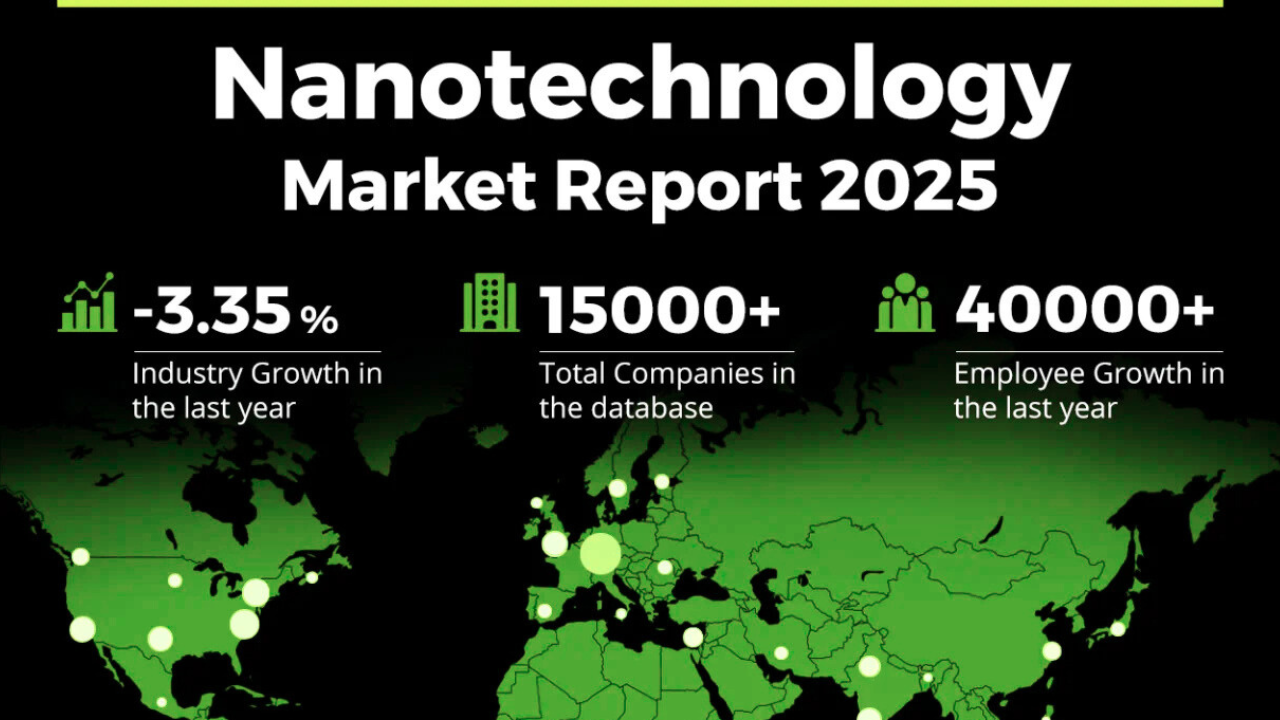
Nanotechnology continues to reshape industries by enabling precision at the molecular level, offering solutions to challenges in scalability, environmental sustainability, and regulatory compliance. The 2025 Nanotechnology Market Outlook provides a detailed examination of the sector’s trajectory, projecting a global market size of USD 115.41 billion by 2034, with a compound annual growth rate (CAGR) of 33.14% from 2025 to 2034. Despite a slight contraction in 2024 (-3.35% annual growth rate), the industry demonstrates resilience through significant intellectual property activity (over 615,000 patents), robust investment (12,000+ funding rounds), and employment growth (40,000 new hires). This report, tailored for a PhD-level and advanced research audience, analyzes key trends in drug delivery, advanced materials, and quantum computing, while spotlighting innovative startups such as Nanize, Infrascreen, and NcodiN. It also explores the investment landscape, with top investors like JP Morgan and TSMC committing over USD 3 billion, and examines geographical hubs driving innovation, including the USA, Poland, and India. By addressing market dynamics, technological advancements, and future opportunities, this outlook offers actionable insights for stakeholders, investors, and policymakers navigating the nanotechnology ecosystem.
1. Introduction
1.1 Background and Rationale
Nanotechnology, the science of manipulating materials at the nanoscale (1–100 nanometers), has emerged as a transformative force across industries, enabling breakthroughs in healthcare, electronics, energy, and materials science. By enhancing material properties such as strength, conductivity, and biocompatibility, nanotechnology addresses critical challenges in scalability, environmental impact, and regulatory compliance. However, the sector faces hurdles, including production bottlenecks and complex regulatory frameworks, which necessitate a comprehensive understanding of market dynamics and innovation trends.
The 2025 Nanotechnology Market Outlook aims to provide a data-driven analysis of the industry’s current state and future potential. Despite a slight market contraction in 2024 (-3.35% annual growth rate), the sector exhibits strong fundamentals, with over 15,000 companies, 615,000 patents, and a workforce of 800,000 globally. This report synthesizes proprietary data from the StartUs Insights Discovery Platform, supplemented by external market forecasts, to offer insights into growth projections, investment landscapes, and technological advancements for advanced research audiences.
1.2 Aim and Scope of the Study
This study seeks to evaluate the nanotechnology market’s trajectory in 2025, focusing on its growth metrics, key trends, and innovative applications. It examines the sector’s impact on healthcare (drug delivery), materials science (advanced materials), and electronics (quantum computing), while highlighting investment opportunities and startup ecosystems. The scope includes an analysis of global market size, funding activities, geographical hubs, and regulatory considerations, providing a holistic view for stakeholders, investors, and policymakers.
2. Methodology
2.1 Data Collection and Analysis
This report leverages proprietary data from the StartUs Insights Discovery Platform, which tracks 25 million companies and 20,000 technologies globally, including 5 million startups and scaleups. The platform’s trend intelligence feature was utilized to analyze nanotechnology’s evolution over the past five years, focusing on key metrics such as:
Total companies and startups (15,000+ companies, 667 startups)
Annual growth rate (-3.35% in 2024)
News coverage (4,900+ publications)
Funding activity (12,000+ rounds, USD 12.5 million average per round)
Patents (615,000+ from 109,000 applicants)
Grants (8,900+ awarded)
Global search volume growth (-1.42% yearly)
External market reports from Precedence Research, The Business Research Company, Industry Arc, and Imarc were reviewed to provide broader market projections, ensuring a comprehensive and reliable analysis.
2.2 Analytical Framework
The analysis ranks nanotechnology among the top 5% of 20,000 tracked topics, assessing its performance across news coverage, funding, manpower, patents, and grants. Subtrends such as drug delivery, advanced materials, and quantum computing were evaluated for their market maturity, employment growth, and innovation potential. The report also incorporates firmographic insights, funding stage distributions, and geographical heatmaps to identify key hubs and investment trends.
3. Market Overview and Growth Projections
3.1 Global Market Size and Forecasts
The global nanotechnology market was valued at USD 6.59 billion in 2024, with projections estimating growth to USD 115.41 billion by 2034, at a CAGR of 33.14% (Precedence Research). Alternative forecasts suggest the market could reach USD 332.73 billion by 2032 (CAGR 17.6%) or USD 102.8 billion by 2033 (CAGR 27.68%, Imarc). The nanotechnology services segment is expected to grow from USD 209.89 billion in 2025 to USD 311.58 billion by 2029, at a CAGR of 10.4% (The Business Research Company). Despite a slight contraction in 2024 (-3.35%), the sector’s long-term growth trajectory remains robust, driven by advancements in healthcare, electronics, and materials science.
3.2 Industry Dynamics
The nanotechnology sector employs over 800,000 workers globally, adding 40,000 new employees in 2024. Intellectual property activity is a key strength, with 615,000 patents filed by 109,000 applicants, growing at 4.10% annually. The USA and China lead in patent issuance, contributing 173,000 and 166,000 patents, respectively. North America holds a dominant 39% market share, valued at USD 2.57 billion in 2024, with a projected CAGR of 33.15%.
4. Investment Landscape
4.1 Funding Activity
The nanotechnology market demonstrates a robust investment landscape, with over 12,000 funding rounds supported by 6,500 investors. The average investment per round is USD 12.5 million, with 2,800 companies receiving financial support. The U.S. 2025 budget allocates USD 2.2 billion to the National Nanotechnology Initiative, emphasizing research and development in applications across industries.
4.2 Top Investors
Leading investors have collectively committed over USD 3 billion to nanotechnology. Key players include:
JP Morgan: USD 674 million across 2 companies, with a USD 50 million pledge for sustainable growth in the UK.
JSR Corporation: USD 523.3 million supporting 4 companies, including Aillis, Inc., an AI medical device company.
TSMC: USD 432.8 million across 2 companies, securing USD 6.6 billion in grants and USD 5 billion in loans under the CHIPS Act.
International Finance Corporation (IFC): USD 401 million across 2 companies, partnering on sustainable infrastructure projects.
Sartorius: USD 364.3 million in 2 companies, collaborating with NVIDIA on AI-driven drug discovery.
Other notable investors include Samsung (USD 361.7 million), Global Emerging Markets (USD 346.7 million), Da Vinci Capital (USD 332.5 million), Invus (USD 311.2 million), and Fidelity Investments (USD 284.4 million).
5. Geographical Hubs and Global Footprint
5.1 Key Countries and Cities
The nanotechnology industry is concentrated in leading hubs, with the USA, Poland, India, the UK, and Germany driving innovation. Key cities include Warsaw, London, New York City, Singapore, and Cambridge, which host significant clusters of companies, startups, and research institutions. North America’s dominance (39% market share) underscores its leadership in funding, patents, and market activity.
5.2 Company Distribution
The sector comprises over 15,000 companies, including 950 early-stage firms and 550 involved in mergers and acquisitions, indicating active restructuring and market consolidation. This distribution reflects a dynamic ecosystem with opportunities for both emerging and established players.
6. Key Trends and Innovations in Nanotechnology
6.1 Drug Delivery
Nanotechnology enables precision drug delivery by targeting disease sites at the molecular level, enhancing efficacy and minimizing side effects. This subtrend involves over 2,000 companies and 150,000 employees, with 8,000 new hires in 2024 and a 3.37% annual growth rate. Applications include nanoparticle-based systems for cancer treatment and mental health therapies, as exemplified by startups like Madrigal Mental Care.
6.2 Advanced Materials
Nanotechnology enhances material properties such as strength, conductivity, and durability, supporting industries like automotive, aerospace, and electronics. This trend encompasses 2,800+ companies employing 280,000 people, with 13,000 new hires in 2024 and a 13.87% annual growth rate. Innovations include sustainable coatings and high-performance composites, as seen in Nanize’s polysilazane-based solutions.
6.3 Quantum Computing
Nanotechnology drives breakthroughs in quantum computing by enabling stable qubits and advanced quantum chips, improving processing power for complex problem-solving. This sector involves 9,900 companies and 470,000 employees, with 36,000 new hires in 2024 and a 6.03% annual growth rate. NcodiN’s nano-optoelectronic devices highlight the potential for high-density interconnects in next-generation computing.
7. Spotlight on Innovative Nanotechnology Startups
7.1 Nanize: Polysilazane-Based Coatings
Norwegian startup Nanize develops polysilazane-based coatings using nanoparticles to create PFAS-free, durable surface protection for glass, metal, and plastic. These coatings cure in under one minute at low temperatures, offering anti-graffiti and anti-soiling properties while meeting regulatory standards for sustainability. Nanize’s technology enhances industrial efficiency and provides an eco-friendly alternative to traditional coatings.
7.2 Infrascreen: Greenhouse Screens
Swiss startup Infrascreen designs transparent aluminum screens with nanotechnology-based coatings to improve thermal insulation in greenhouses. By reflecting outgoing thermal radiation, the screens maintain optimal growing temperatures, reducing energy costs while preserving humidity transmission and durability. Infrascreen’s solution integrates seamlessly with existing systems, offering a sustainable option for modern agriculture.
7.3 KorganoTech: Nanotechnology-Based Air Filters
U.S.-based KorganoTech develops air filters using bioactive metal particles (e.g., silver, copper) embedded in a porous nanowire web. These filters trap pathogens and release metal ions to disrupt microbial growth, ensuring effective air quality control in residential and commercial settings. The multilayer structure enhances durability, making KorganoTech a leader in health-conscious air filtration.
7.4 Madrigal Mental Care: Organic Nanoparticle Delivery System
Israeli startup Madrigal Mental Care leverages organic nanoparticles to deliver psychedelic compounds (e.g., psilocybin, ketamine) via intranasal spray for mental health treatment. By bypassing the digestive system, this system ensures rapid, targeted delivery to the brain, addressing conditions like PTSD and drug-resistant depression with minimal side effects. Madrigal’s approach offers a novel therapeutic option for challenging disorders.
7.5 NcodiN: Nano-Optoelectronic Devices
French startup NcodiN develops nanolasers and nanodetectors using III-V semiconductors, integrating electronics and photonics on a single chip. With over 10,000 high-density interconnects per square centimeter, NcodiN’s technology enhances data processing speed and energy efficiency, targeting applications in next-generation computing and telecommunications. This innovation supports the demand for high-bandwidth, power-efficient infrastructure.
8. Discussion
8.1 Challenges and Opportunities
The nanotechnology sector faces challenges in scaling production processes, managing environmental impacts, and navigating regulatory frameworks. The slight market contraction in 2024 (-3.35%) reflects these hurdles, alongside a decline in global search growth (-1.42%). However, opportunities abound, driven by strong investment (USD 3 billion from top investors), employment growth (40,000 new hires), and intellectual property development (615,000+ patents). Trends in drug delivery, advanced materials, and quantum computing position nanotechnology as a key enabler of innovation across industries.
8.2 Future Directions
Future growth in nanotechnology will hinge on addressing scalability and sustainability challenges through advanced manufacturing techniques and eco-friendly materials. Continued investment in research and development, supported by initiatives like the U.S. National Nanotechnology Initiative (USD 2.2 billion), will drive breakthroughs in healthcare, electronics, and materials science. Collaborative efforts between startups, investors, and policymakers will be critical to realizing nanotechnology’s full potential.
9. Conclusion
The 2025 Nanotechnology Market Outlook underscores the sector’s transformative potential, projecting significant growth to USD 115.41 billion by 2034 at a CAGR of 33.14%. Despite a slight contraction in 2024, the industry remains dynamic, with robust investment, employment growth, and intellectual property activity. Key trends in drug delivery, advanced materials, and quantum computing highlight nanotechnology’s role in addressing global challenges, while innovative startups like Nanize, Infrascreen, and NcodiN exemplify the sector’s diversity and impact. For stakeholders, investors, and researchers, this report offers a roadmap to navigate the nanotechnology landscape, emphasizing the need for continued innovation and collaboration to unlock future opportunities.
References
Precedence Research, 2024. Global Nanotechnology Market Size Report.
The Business Research Company, 2024. Nanotechnology Services Market Forecast.
Industry Arc, 2024. Nanotechnology Market Size and Growth Projections.
Imarc, 2024. Nanotechnology Market Growth Analysis.
StartUs Insights Discovery Platform, 2025. Nanotechnology Market Data.
You Might Be Interested In
- International Conference on NanoMaterials and Sustainable Applications
- Postdoctoral Research Opportunity in Image Processing for Bioimaging at TU Delft
- Exploring the Nanotechnology Clothing Market: Trends, Segmentation, and Future Growth Forecast (2025–2029)
- Purdue Advances in 2D Nanomaterials for Extreme Environments