
12
Materials rarely fail all at once. A polymer component can accumulate microscopic cracks under repeated loading, a coating can develop a defect, or a composite can gradually lose its mechanical integrity long before catastrophic failure becomes visible.
The fundamental challenge is a materials paradox. A highly crosslinked polymer can provide stiffness and dimensional stability, but its restricted molecular mobility makes autonomous repair difficult. Increasing molecular mobility can improve healing, yet excessive mobility can compromise mechanical strength and promote creep. Nanotechnology does not eliminate this trade-off, but it provides a way to control where mechanical reinforcement, molecular mobility, reactive chemistry, and energy dissipation occur. This spatial control is becoming one of the defining strategies in self-healing materials research.
What Happens When a Material Heals?
A self-healing material is an engineered substance capable of autonomously or externally repairing physical damage such as microcracks or void formation to restore structural integrity and functional properties (e.g., tensile strength, conductivity, barrier protection) without permanent loss of performance.
When a crack forms, the material does more than simply separate into two surfaces. At the crack tip, mechanical energy is concentrated into a highly localized region where polymer chains can stretch, disentangle, break, and undergo irreversible or reversible chemical changes.
For a material to heal, those damaged interfaces must regain sufficient contact and molecular mobility for the relevant interactions to reform. Depending on the material, recovery may involve polymer-chain diffusion, reversible hydrogen bonding, dynamic covalent exchange, physical rearrangement, or the delivery of a new reactive species.
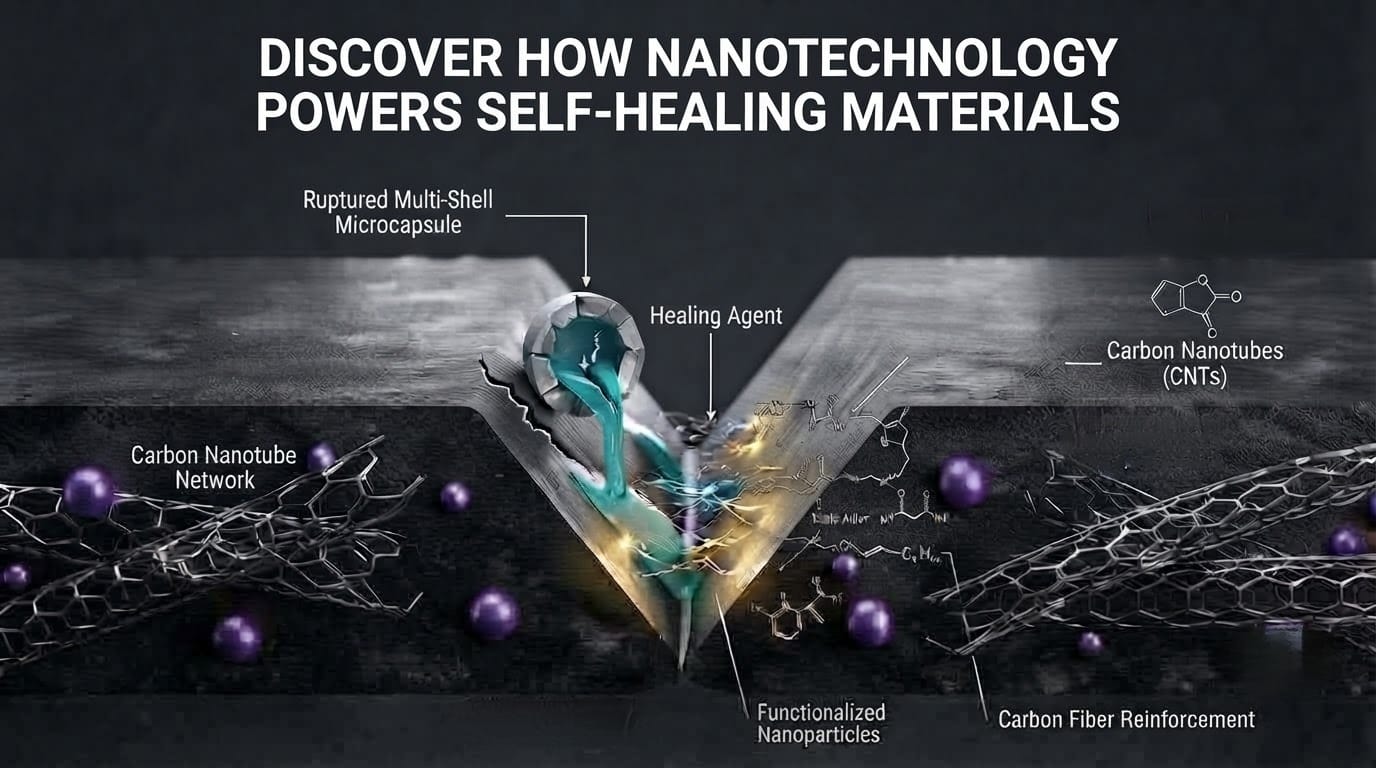
This is where the distinction between extrinsic and intrinsic self-healing becomes important. Extrinsic systems store a finite repair agent in capsules or vascular structures that is released when damage occurs. Intrinsic systems build reversible chemistry directly into the material, allowing the network itself to reorganize.
At the nanoscale, the problem becomes one of controlling interfaces. Nanofillers can alter stress transfer and energy dissipation, while nanoscale containers can localize reactive chemistry. The objective is not simply to close a visible crack, but to manipulate the molecular processes occurring around the damaged region before small defects develop into larger fractures.
Nanocapsules: Bringing Repair Chemistry to the Damage
One approach is to place a healing agent inside a container that ruptures, opens, or responds when a crack reaches it. Conventional microcapsules remain an important platform, particularly in polymer coatings and structural composites, but their incorporation can influence the mechanical properties of the host matrix.
Nanocontainers introduce a different design space. Advanced micro- and nanocapsule systems can incorporate healing agents, catalysts, corrosion inhibitors, or other functional species, with architectures ranging from polymeric nanocapsules and polymersomes to liposomes and other nanostructured carriers.
The physics of transporting a liquid into a narrow crack is particularly important. Capillary-driven infiltration is commonly described using the Lucas–Washburn relation:
L² = (γr cos θ / 2η)t
where L is the penetration distance, γ is the liquid surface tension, r is the characteristic pore or channel radius, θ is the contact angle, η is the viscosity, and t is time.
The relationship highlights an important nanoscale constraint: penetration depends strongly on both geometric confinement and interfacial wetting. As characteristic dimensions become smaller, successful delivery increasingly depends on favorable surface energetics and sufficiently low viscosity. Real cracks are also rough, tortuous, chemically heterogeneous, and transient, so the classical Lucas–Washburn model is an approximation rather than a complete description.
This makes nanocontainer engineering a surface-chemistry problem as much as a materials problem. Shell chemistry, interfacial energy, particle dispersion, payload viscosity, and release kinetics can determine whether a healing agent actually reaches the damaged region. The resulting advantage is spatial localization rather than modifying the entire polymer to become more mobile, the repair chemistry can be concentrated where it is needed.
Dynamic Polymer Networks: Healing Without a Finite Reservoir
A different strategy removes the need for a stored repair agent altogether. Dynamic polymer networks incorporate interactions or chemical bonds that can reversibly break and reform. These may include hydrogen bonds, disulfide bonds, imines, boronate esters, transesterification reactions, and other dynamic covalent chemistries.
After damage, molecular rearrangement can reconnect the interfaces when sufficient contact, mobility, and appropriate chemical conditions are available. Unlike capsule-based systems, these materials can potentially heal multiple times because the repair mechanism is embedded throughout the network rather than consumed at the first damage event.
Nanofillers add another level of control. Nanoparticles, nanotubes, graphene-derived nanosheets, and other nanostructures can reinforce the polymer network, alter thermal and electrical properties, and introduce additional interfaces for stress transfer.
But the interface can also become a liability. Strong polymer–nanofiller interactions can immobilize chain segments near the filler surface, producing an interphase with restricted segmental mobility. In some systems this behavior is described in terms of a rigid amorphous fraction (RAF). The resulting interfacial confinement can alter local glass-transition behavior and slow molecular relaxation. If polymer segments become too strongly anchored, the same nanofiller that improves strength can hinder the molecular rearrangement required for healing.
This creates a central design problem: the nanofiller must reinforce the material without turning the surrounding polymer into an immobile interfacial layer. Surface-grafted dynamic ligands, tailored interfacial chemistry, and controlled filler dispersion are therefore being investigated as ways of making the interface participate in, rather than suppress, network rearrangement.
Stimulus-Responsive Healing: Activating Repair at the Nanoscale
Some self-healing materials do not heal efficiently under ambient conditions. Instead, an external stimulus provides the energy needed to activate molecular rearrangement. Heat is one of the simplest approaches, but nanoscale materials can make heating spatially selective. Photothermal nanomaterials such as MXene-based fillers can convert near-infrared irradiation into heat, enabling localized thermal activation of dynamic polymer networks. In one recent polyurethane system incorporating MXene () /polydopamine hybrids, near-infrared irradiation produced rapid heating and enabled healing within tens of minutes, with reported healing efficiency of 82.7 percent under the tested conditions.
Magnetic nanoparticles provide another route. Iron-oxide nanoparticles dispersed in polymers can generate localized heat when subjected to an alternating magnetic field. Researchers have used this mechanism to activate polymer mobility and seal damage, including localized healing of early-stage fatigue damage.
The important concept is remote energy delivery. Instead of heating an entire component, nanostructured fillers can convert an external field or light stimulus into localized thermal energy. The practical challenge is controlling temperature, energy deposition, nanoparticle dispersion, and repeated-cycle stability without damaging the surrounding material.
The Modulus–Mobility Paradox: Interfacial Nanomechanics and Multi-Cycle Fatigue
Closing a crack is not necessarily the same as restoring mechanical performance. A material may appear visually healed while retaining changes in stiffness, toughness, fracture resistance, or fatigue life. For this reason, researchers increasingly need quantitative fracture-mechanics measurements rather than relying solely on the percentage of a crack that disappears.
One important parameter is the critical strain energy release rate Gᵢc which describes the energy required for a crack to propagate under a specified fracture mode. Measuring fracture properties can therefore reveal whether a healing mechanism has actually restored resistance to crack growth.
Repeated healing presents an even harder test. A 2025 study of dynamic poly(dithiourethane) vitrimers published in Macromolecules / Advanced Functional Materials demonstrated healing efficiency of up to 77 percent after 24 hours at 25°C. Increasing the temperature or healing time produced substantially higher recovery. However, after four healing cycles under the 25°C/24-hour condition, healing efficiency decreased from 77 percent to 16 percent.
That decline illustrates an important principle: self-healing is not automatically regenerative indefinitely. Repeated damage can alter network topology, consume or rearrange reactive sites, introduce irreversible defects, and progressively change molecular mobility.
Magnetic nanoparticle systems provide another perspective. In Fe₃O₄-containing polymers, localized induction heating has been used to address early fatigue damage by promoting deformation recovery and crack sealing. Such approaches demonstrate how nanoscale heat generation can target damage that is difficult to repair through passive molecular diffusion alone. The engineering objective is therefore shifting from simply maximizing initial healing efficiency toward maximizing recovery under realistic loading and repeated damage.
The Horizon: From Crack Closure to Restoring Engineered Function
For many applications, mechanical crack closure is only the beginning. A self-healing coating may need to recover its barrier function. A conductive polymer may need to restore an electrical pathway. A structural composite may need to recover sufficient fracture resistance. A flexible electronic material may need to regain both mechanical integrity and signal transmission.
This is where multifunctional nanomaterials become particularly interesting. A percolated network of conductive nanoparticles, graphene, carbon nanotubes, or other nanoscale fillers can simultaneously provide mechanical reinforcement and an electrical signal that changes when the network is disrupted.
In principle, this electrical response could form part of a closed-loop healing architecture in which damage first produces a measurable change in impedance across the conductive nanonetwork. That signal could then be used to trigger localized activation, generating nanoscale heat through mechanisms such as Joule or photothermal heating. The resulting thermal stimulus could promote dynamic bond exchange and molecular rearrangement within the damaged region, followed by partial restoration of the conductive pathway and its associated electrical response. Such an architecture would integrate damage sensing, targeted activation, and material recovery within a single system, although reliable autonomous implementation remains an emerging research challenge.
Such systems are still an emerging research direction rather than a universal capability. Nevertheless, the architecture points toward materials that do more than passively contain a healing mechanism. They could combine damage sensing, localized energy delivery, molecular repair, and functional verification within the same material platform.
Where Self-Healing Nanomaterials Can Be Used
The same nanoscale mechanisms that enable repair can be adapted to different engineering functions. Protective coatings are among the most developed applications: micro- and nanocontainers can release healing agents or corrosion inhibitors when a coating is damaged, helping restore barrier performance and protect the underlying metal. Recent studies have demonstrated self-healing anticorrosion coatings for steel and other metallic substrates, including systems designed for demanding marine environments.
In structural and fatigue-resistant polymer composites, embedded nanofillers can provide both reinforcement and stimulus-responsive healing. For example, Fe₃O₄ nanoparticle-containing ionomer composites have been investigated for healing early-stage fatigue damage through localized inductive heating under an alternating magnetic field.
Self-healing nanocomposites are also being explored for flexible electronics, wearable devices, adhesives, biomedical materials, and other functional systems, where recovering electrical, mechanical, or interfacial properties can be more important than complete restoration of the original material. However, these applications remain at different stages of development; practical deployment still requires reliable multicycle healing, environmental durability, and preservation of mechanical performance.
Toward Autonomous Nanomaterial Systems
The long-term goal is not simply a material that heals after being damaged. It is a material that can determine when, where, and how much healing is required. Nanotechnology is well suited to this problem because mechanical, chemical, optical, magnetic, and electrical behavior can be engineered at comparable length scales. A nanoscale filler can reinforce a polymer, generate heat, modify interfacial chemistry, and contribute to electrical sensing. A nanocontainer can localize a reactive molecule. A dynamic polymer network can provide the reversible chemistry needed for recovery.
The resulting architecture resembles a distributed repair system: damage changes a local physical signal; that signal triggers an appropriate stimulus; the stimulus activates molecular rearrangement; and the restored material changes the signal again. Achieving this reliably will require more than higher healing percentages. Future systems will need to demonstrate controlled healing depth, mechanical recovery, multicycle durability, environmental stability, predictable activation thresholds, and minimal degradation of the original material properties.
The most important shift, therefore, is conceptual. Self-healing materials are moving from the idea of closing cracks toward the engineering of materials that can sense damage, localize a response, reorganize their molecular structure, and recover useful function.
At that scale, nanotechnology is not simply making materials smaller. It is giving researchers a way to control where chemistry, mechanics, energy, and information meet and that may ultimately determine how far self-healing materials can move from laboratory demonstrations toward durable engineering systems.
References:
- Adil, M. M.; Rabbi, M. S.; Tasnim, T. Development of Microcapsule-Based Self-Healing Composite: A Critical Review on Influencing Factors of Microencapsulation, Healing Efficiency, Thermal Stability and Application. Alexandria Engineering Journal, 2025, 122, 1–17. DOI: 10.1016/j.aej.2025.02.092.
- Ahmed, A. S.; Ramanujan, R. V. Magnetic Field Triggered Multicycle Damage Sensing and Self Healing. Scientific Reports, 2015, 5, 13773. DOI: 10.1038/srep13773.
- Gupta, R.; Gupta, P.; Footer, C.; Stenning, G. B. G.; Darr, J. A.; Pancholi, K. Tuneable Magnetic Nanocomposites for Remote Self-Healing. Scientific Reports, 2022, 12, 10180. DOI: 10.1038/s41598-022-14135-8.
- Han, G.; Yang, W.; Ling, H.; Liu, H.; Ren, S. Research Progresses in Methods for Improving the Properties of Dynamic Covalent Polymer Networks. Macromolecular Chemistry and Physics, 2025, 226, 2400461. DOI: 10.1002/macp.202400461.
- Kartsonakis, I. A.; Kontiza, A.; Kanellopoulou, I. A. Advanced Micro/Nanocapsules for Self-Healing Coatings. Applied Sciences, 2024, 14, 8396. DOI: 10.3390/app14188396.
- Li, X.; et al. Mechanically Robust, Intrinsic Self-Healing Polyurethane Enabled by NIR-Photothermal Conversion of MXene/Polydopamine Hybrids. ACS Applied Materials & Interfaces, 2025. DOI: 10.1021/acsami.5c17591.
- Oberhausen, B.; Kickelbick, G. Induction Heating Induced Self-Healing of Nanocomposites Based on Surface-Functionalized Cationic Iron Oxide Particles and Polyelectrolytes. Nanoscale Advances, 2021, 3, 5589–5604. DOI: 10.1039/D1NA00417D.
- Pommella, A.; Griffiths, P.; Coativy, G.; Dalmas, F.; Ranoo, S.; Schmidt, A. M.; Méchin, F.; Bernard, J.; Zinn, T.; Narayanan, T.; Meille, S.; Baeza, G. P. Fate of Magnetic Nanoparticles during Stimulated Healing of Thermoplastic Elastomers. ACS Nano, 2023, 17, 17394–17404. DOI: 10.1021/acsnano.3c05440.
- Post, W.; Bose, R. K.; García, S. J.; Van der Zwaag, S. Healing of Early Stage Fatigue Damage in Ionomer/Fe₃O₄ Nanoparticle Composites. Polymers, 2016, 8, 436. DOI: 10.3390/polym8120436.
- Sharma, S. K.; Gajević, S.; Sharma, L. K.; Sharma, Y.; Sharma, M.; Ivanović, L.; Milojević, S.; Stojanović, B. Self-Healing Polymer Nanocomposites: Mechanisms, Structure–Property Relationships, and Emerging Applications. Polymers, 2026, 18, 276. DOI: 10.3390/polym18020276.
- Yang, H.; Yan, C. Dynamic Covalent Polymer Nanocomposites: Engineering Network Structures for Multifunctional Properties. ACS Applied Polymer Materials, 2026, 8, 7594–7618. DOI: 10.1021/acsapm.6c00818.
- Yoshida, et al. Self-Healing and Recycling Properties of Networked Polydithiourethanes With Reversible Crosslinked Moieties via Hydrogen and Dynamic Covalent Bonding. Journal of Polymer Science, 2025, 63, 3301–3312. DOI: 10.1002/pol.20250263.