
3
A nanomaterial that loses its electrical conductivity during storage or oxidizes before reaching its intended application is difficult to commercialize, regardless of how impressive its initial properties may be. Although nanoscale engineering enables exceptional optical, catalytic, electrical and magnetic performance, the same high surface-area-to-volume ratio and surface reactivity that make nanomaterials valuable can also make them vulnerable to environmental degradation. Exposure to oxygen, moisture, temperature fluctuations, light and reactive chemicals can progressively alter their composition, morphology and functionality.
Maintaining nanomaterial stability beyond controlled laboratory conditions is therefore a major challenge for researchers and manufacturers. Nanomaterial degradation can compromise product reliability, shorten shelf life, increase production costs and introduce batch-to-batch variability. To address these limitations, scientists are moving beyond conventional post-synthesis treatments towards advanced surface engineering, protective encapsulation, defect control and stability-oriented material design.
Understanding the Mechanisms of Nanomaterial Degradation
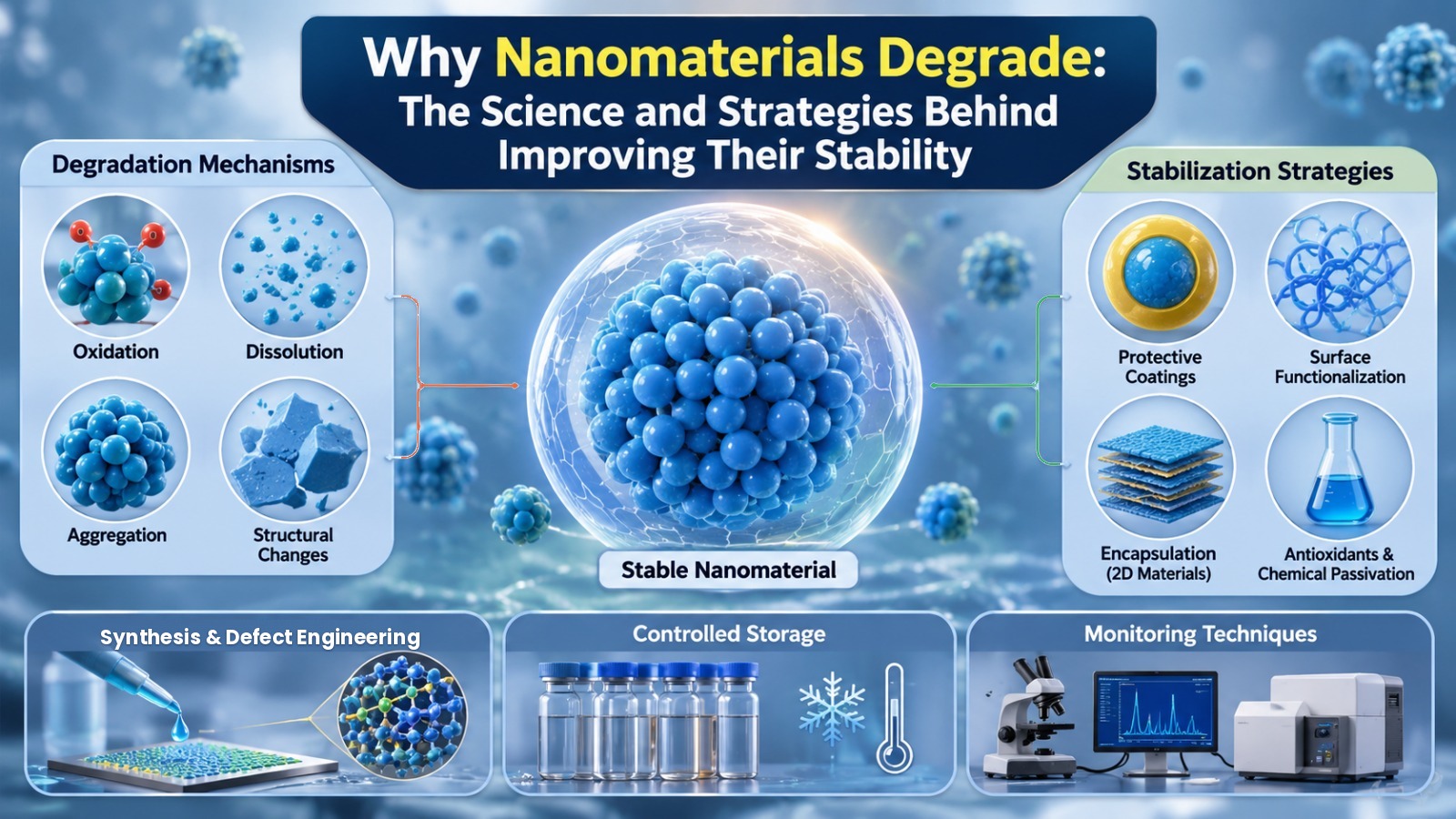
Nanomaterial degradation involves several physical and chemical processes that often act simultaneously. The dominant mechanism depends on material composition, particle size and shape, surface chemistry and environmental conditions.
- Oxidation: Exposure to oxygen, water or other oxidizing species can convert reactive nanomaterial surfaces into oxides, altering their chemical composition and functional properties. Titanium carbide MXenes, particularly Ti₃C₂Tₓ (where Tₓ denotes surface terminations such as –O, –OH and –F), are especially susceptible in aqueous dispersions, where they gradually convert into titanium dioxide (TiO₂, predominantly anatase) together with carbon-containing by-products [1,2]. In one study, delaminated Ti₃C₂Tₓ dispersions stored in open vials had degraded by approximately 42%, 85% and 100% after 5, 10 and 15 days, respectively [1]. Oxidation typically begins at flake edges and defect sites, so smaller flakes, which have a higher proportion of edge atoms, generally degrade faster [1,3,4]. The transformation reduces the fraction of intact nanosheets and compromises electrical conductivity and electrochemical performance.
- Hydrolysis and moisture-driven reactions: Some nanomaterials react directly with water, and in practice hydrolysis and oxidation are frequently coupled. Huang and Mochalin showed that water itself, rather than dissolved oxygen alone, plays the central role in the degradation of Ti₃C₂Tₓ and Ti₂CTₓ MXene colloids: MXenes dispersed in argon-saturated water still converted to TiO₂, whereas those in oxygen-saturated isopropanol showed no detectable oxidation over a similar period [2]. Black phosphorus (BP) degrades through a related coupled process. Light-assisted reaction with oxygen (photo-oxidation) forms phosphorus oxide species (POₓ) on the surface; these hydrophilic oxides take up water and are converted into soluble phosphorus oxoacids, progressively thinning the flakes [5,6]. The degradation rate increases with light intensity and oxygen concentration and is faster for thinner flakes, and it significantly alters the electronic and optical properties of BP [5].
- Aggregation and agglomeration: Nanoparticles associate into larger clusters when attractive van der Waals forces outweigh electrostatic or steric repulsion. Agglomerates are held together by weak forces and can often be redispersed, whereas aggregates are bound by strong interactions, such as sintered necks or chemical bonds, and are difficult to reverse. High ionic strength, pH values close to the isoelectric point and the desorption of stabilizing ligands all promote clustering. Although aggregation is not necessarily chemical degradation, it reduces the accessible surface area and can compromise catalytic activity, colloidal stability and performance in biomedical formulations.
- Dissolution, coarsening and structural degradation: Some nanomaterials dissolve and release ions into their surroundings; silver nanoparticles, for example, undergo oxidative dissolution to release Ag⁺, and silica slowly dissolves in aqueous media [7]. Because solubility increases as particle size decreases (the Gibbs–Thomson effect), small particles can dissolve and redeposit onto larger ones (Ostwald ripening), while at elevated temperatures supported particles can migrate and coalesce (sintering), a major cause of catalyst deactivation. Surface reconstruction, defect propagation and mechanical damage can further alter nanoscale structures, and these processes may be accelerated by thermal cycling, chemical exposure and repeated operational stress.
Identifying the dominant degradation mechanism is essential because oxidation, hydrolysis, aggregation and structural deterioration require different stabilization approaches, and because several of these mechanisms frequently operate at the same time.
Protective Coatings and Core–Shell Engineering
One of the most established approaches to improving nanomaterial stability is the development of protective coatings and core–shell structures. In this architecture, a functional nanoparticle core is surrounded by a protective shell that restricts direct exposure to oxygen, moisture and reactive chemicals. Depending on the material system, these barriers can consist of silica, alumina, carbon, noble metals such as gold, or suitable polymers.
Gold-coated iron nanoparticles (Fe@Au) illustrate both the potential and the limitations of this approach. Uncoated zero-valent iron nanoparticles oxidize readily, whereas a gold shell, owing to the high chemical stability of gold, can delay oxidation of the iron core [8]. However, the effectiveness of a protective shell depends on its thickness, uniformity, porosity, adhesion and chemical compatibility with the surrounding environment; incomplete or porous shells allow oxygen and water to reach the core, as discussed in the section on storage below.
Research by Yang and colleagues highlights a further limitation: the protective shell can itself degrade [7]. Using luminescent silver nanodots encapsulated in silica (AgND@SiO₂) as a probe, they found that silica nanoparticles were relatively stable in water and phosphate-buffered saline but were eroded in cell culture medium and blood, exposing the encapsulated core. The erosion was attributed to the synergistic action of medium components, particularly compounds containing amino groups [7]. Consequently, protective coatings must be evaluated not only for their initial barrier performance but also for their long-term chemical stability under application-specific conditions.
Surface Functionalization and Polymer-Based Stabilization
Surface functionalization modifies the chemical characteristics of nanomaterials to control their interactions with surrounding environments. Researchers use polymer grafting, ligand engineering and surface passivation to improve dispersion stability, reduce unwanted surface reactions and introduce additional protective properties. Colloidal stabilization can be electrostatic, where charged ligands such as citrate create repulsive electrical double layers; steric, where surface-bound polymer chains physically prevent close contact; or a combination of both (electrosteric).
Polyethylene glycol (PEG) functionalization is a widely used approach for modifying nanoparticle surfaces. Polymer chains attached to particle surfaces provide steric stabilization by creating a hydrated barrier that reduces close particle–particle contact. In biomedical applications, PEGylation also reduces protein adsorption and can prolong circulation time. However, PEG coatings primarily improve colloidal stability; they do not necessarily prevent oxidation or dissolution of the underlying core, and PEG chains can themselves undergo oxidative degradation over time.
Polymer encapsulation offers another route to protecting sensitive nanomaterials. Materials such as poly(methyl methacrylate) (PMMA) and other polymeric coatings can reduce environmental exposure and help preserve the properties of two-dimensional materials and nanoscale devices [9]. Their effectiveness, however, depends on permeability, adhesion, thermal resistance and chemical compatibility. Because most polymers are gradually permeable to water and oxygen, polymer capping alone generally slows rather than prevents degradation. A polymer layer that provides excellent dispersion stability may not necessarily offer sufficient protection against oxidation or high-temperature operation.
Encapsulation of Two-Dimensional Nanomaterials
Two-dimensional (2D) materials consist almost entirely of surface atoms, making environmental interactions a dominant factor in their stability. Black phosphorus, discussed above, is the most prominent example [5,6]. Several transition-metal dichalcogenides, particularly tellurides such as MoTe₂ and WTe₂, and other layered semiconductors such as InSe also degrade in air, typically starting at defects, grain boundaries and exposed edges [9,10].
To address these limitations, scientists are developing encapsulation architectures that isolate sensitive materials from their surroundings. Hexagonal boron nitride (h-BN) and graphene are widely used as protective layers: both are atomically flat, chemically inert and, when defect-free, effectively impermeable to gases. h-BN is additionally a wide-bandgap insulator (approximately 6 eV) with few dangling bonds or charge traps, so it can protect an encapsulated layer without short-circuiting or strongly doping it; graphene, being electrically conductive, is better suited to applications in which electrical contact is acceptable or desired. Sensitive flakes are commonly sandwiched between h-BN layers by dry transfer inside an inert-atmosphere glovebox, which restricts environmental exposure while preserving electronic quality [9].
Atomic layer deposition (ALD) provides another important solution. This thin-film deposition technique relies on sequential, self-limiting surface reactions to produce highly conformal, thickness-controlled coatings, including ultrathin metal oxide layers. Wood and colleagues showed that ALD-grown aluminium oxide (AlOₓ) overlayers suppressed the ambient degradation of exfoliated black phosphorus transistors, which retained on/off current ratios of about 10³ and mobilities of about 100 cm² V⁻¹ s⁻¹ for more than two weeks in air [6]. Because pristine 2D surfaces offer few nucleation sites, ALD often requires seed layers or surface pretreatment to achieve continuous, pinhole-free films, and both the precursors and the process temperature must be compatible with the sensitive material.
Other approaches described in the literature include mechanical transfer of protective layers, polymer capping, controlled in situ oxidation to form a self-limiting passivating oxide, and surface functionalization [9]. However, achieving uniform, defect-free encapsulation over large areas remains a manufacturing challenge [10]. Protective layers must also avoid introducing unwanted doping, strain, charge trapping or optical losses into the underlying material.
Antioxidants and Chemical Passivation
Oxidation-sensitive materials such as MXenes have stimulated considerable interest in chemical stabilization. In Ti₃C₂Tₓ MXenes, exposed flake edges, defects and reactive surface sites can facilitate oxidation, particularly in aqueous dispersions [3,4]. Chemical passivation aims to reduce the reactivity of these sites, while antioxidant additives can suppress oxidative reactions.
Sodium L-ascorbate is the best-known antioxidant for stabilizing MXene dispersions, and a range of related organic antioxidants has since been examined with varying effectiveness [3,11]. Zhao and colleagues reported that Ti₃C₂Tₓ dispersions stored with sodium L-ascorbate for 21 days at ambient temperature retained their composition, morphology and colloidal stability, and that their electrical conductivity remained orders of magnitude higher than that of untreated controls, even in the presence of water and oxygen [11]. Although ascorbate is a reducing agent, molecular dynamics simulations in the same study indicated that its protective effect arises largely from ascorbate anions associating with the nanosheet surface and restricting the access of water to reactive sites [11].
Edge capping with polyanionic salts has also emerged as an effective strategy. Natu and colleagues exploited the observation that the edges of MXene flakes carry a positive charge, whereas their basal planes are negatively charged. Polyanions such as polyphosphates, polysilicates and polyborates adsorb at the positively charged edges, where oxidation preferentially begins; polyphosphates performed best and, at concentrations of about 0.1 M, suppressed the oxidation of Ti₃C₂Tₓ and V₂CTₓ colloids in aerated water at room temperature for at least three weeks [12]. Nevertheless, stabilizing additives must be assessed for their effects on conductivity, electrochemical performance, purity and compatibility with downstream processing. An additive that extends shelf life but compromises the intended functionality may not be suitable for industrial use.
Improving Stability Through Synthesis and Defect Engineering
An increasingly important direction is preventing degradation during synthesis rather than attempting to correct it after material formation. Defects, vacancies, irregular surface structures and exposed edges can create reactive sites that accelerate oxidation and other degradation processes. Consequently, controlling structural quality during synthesis can directly influence the long-term stability of nanomaterials.
Research on MXenes demonstrates how precursor quality and etching conditions influence defect formation and oxidation susceptibility. Etching in concentrated hydrofluoric acid (HF), combined with sonication-assisted delamination, can introduce vacancies and other defects into Ti₃C₂Tₓ nanosheets and produce small flakes with a high density of reactive edges. The widely adopted minimally intensive layer delamination (MILD) method instead uses a milder LiF/HCl etchant, which generates HF in situ, and allows delamination by manual shaking rather than sonication, yielding larger flakes with fewer defects [13].
The quality of the precursor is equally important. Mathis and colleagues showed that adding excess aluminium during synthesis of the Ti₃AlC₂ MAX phase improved its crystallinity and carbon stoichiometry. The resulting Ti₃C₂Tₓ reached electrical conductivities of up to about 20,000 S cm⁻¹, and its aqueous dispersions had a shelf life of more than ten months under ambient storage, compared with one to two weeks for MXene produced from conventional precursors [14]. Further optimization of etchant concentration, reaction temperature and post-synthesis treatment can help reduce unwanted structural damage, and surface termination engineering provides additional opportunities to tune chemical reactivity. The broader objective is to develop nanomaterials with improved intrinsic stability, reducing their dependence on external protective systems.
Controlled Storage and Environmental Engineering
Even carefully engineered nanomaterials can deteriorate during storage. Temperature, oxygen availability, moisture, light exposure, pH and solvent composition can all influence degradation rates. Consequently, controlling the storage environment is an important component of nanomaterial stabilization.
Researchers use refrigerated or frozen storage, inert atmospheres, vacuum-sealed containers and light-protected packaging to reduce exposure to degradation-promoting conditions. For Ti₃C₂Tₓ, storing aqueous dispersions in sealed, argon-filled containers at about 5 °C markedly slows degradation by excluding dissolved oxygen [1], and aqueous dispersions stored at −80 °C have remained chemically stable for more than 39 weeks [15]. Replacing water with organic solvents such as ethanol or isopropanol also delays degradation, consistent with the central role of water in MXene breakdown [2,15]. These approaches must be selected according to material compatibility, intended application and subsequent processing requirements.
A study by Wu and colleagues on Fe@Au nanoparticles demonstrates the importance of storage conditions [8]. Fe@Au nanoparticles that had previously shown cancer-selective activity were found to lose that activity gradually with storage. Using transmission electron microscopy combined with energy-dispersive X-ray spectroscopy, X-ray diffraction and cell viability tests, the researchers found that dried and reconstituted particles, as well as particles taken up by cells, decomposed into irregular γ-Fe₂O₃ fragments and agglomerated gold clumps, with a corresponding loss of anticancer activity. In contrast, the anticancer properties were well preserved for six months under argon and for at least one year under liquid nitrogen [8].
These findings demonstrate that storage conditions can influence functional lifetime as significantly as the initial synthesis procedure. However, controlled storage generally slows degradation rather than eliminating the underlying susceptibility of a material.
Monitoring Nanomaterial Degradation and Evaluating Stability
Developing effective stabilization strategies requires reliable techniques for detecting and quantifying changes in material composition, structure and functionality. Researchers therefore combine complementary characterization methods to monitor degradation throughout storage and operation [4].
- X-ray diffraction (XRD): Identifies crystallographic changes, phase transformations and the formation of new crystalline compounds during degradation. Amorphous products, such as amorphous titania or phosphorus oxides, and very small crystallites may be missed or produce only broad features.
- X-ray photoelectron spectroscopy (XPS): Provides the elemental composition and chemical (oxidation) states of the top few nanometres of a sample, making it valuable for detecting early oxidation, such as Ti–O components in MXenes or POₓ species in black phosphorus. Because XPS is surface-sensitive and performed under ultra-high vacuum, the results may not fully represent bulk or in-solution states.
- Transmission electron microscopy (TEM) and scanning electron microscopy (SEM): Reveal changes in particle morphology, aggregation, shell integrity and structural damage; when combined with energy-dispersive X-ray spectroscopy (EDS) or electron energy-loss spectroscopy (EELS), they also map local composition. Electron-beam damage must be considered for beam-sensitive materials.
- Raman spectroscopy: Detects changes in vibrational modes that indicate structural disorder, chemical transformation and changes in material quality; for example, the appearance of the anatase TiO₂ band near 150 cm⁻¹ signals MXene oxidation. Laser power should be kept low, because laser heating can itself induce oxidation in sensitive materials such as black phosphorus and MXenes.
- UV–visible spectroscopy: Helps monitor changes in optical absorption and dispersion characteristics and is one of the quickest ways to track the oxidation of MXene colloids, for example through the decrease of the characteristic Ti₃C₂Tₓ absorption band at roughly 750–800 nm [1,4]. Spectral changes must, however, be interpreted alongside complementary techniques.
- Dynamic light scattering (DLS) and zeta potential: DLS measures hydrodynamic size distributions in colloidal systems and helps identify aggregation, while zeta-potential measurements indicate surface charge and electrostatic stability. Because DLS assumes spherical particles and its intensity weighting is dominated by large particles, results for anisotropic materials such as 2D flakes should be treated as relative rather than absolute.
- Inductively coupled plasma mass spectrometry or optical emission spectroscopy (ICP-MS/ICP-OES): Quantifies ions released into the surrounding medium, providing a direct measure of dissolution.
- Electrical and electrochemical measurements: Evaluate whether structural or chemical degradation has affected conductivity, charge-transfer behaviour, capacitance or other application-specific functional properties.
Combining these techniques provides a more complete understanding of degradation than relying on a single characterization method. It also enables researchers to distinguish between changes in chemical composition, particle morphology, dispersion stability and functional performance.
Challenges and the Future of Nanomaterial Stabilization
Despite significant advances, long-term nanomaterial stability remains difficult to guarantee. Protective coatings can develop defects, polymer layers may lose their integrity, chemical stabilizers can interfere with functionality, and laboratory storage conditions may not accurately represent industrial environments. Furthermore, stabilization strategies must be tailored to individual material systems rather than applied universally.
Future research is increasingly directed towards multifunctional and self-healing protective coatings, scalable encapsulation technologies, defect-controlled synthesis, environmentally compatible stabilizers and standardized long-term stability testing. Particular attention is also being given to understanding how protective systems behave under combined stresses, including temperature fluctuations, moisture, mechanical loading and repeated chemical exposure. Accelerated ageing tests at elevated temperature and humidity can shorten evaluation times, but their results must be validated against real-time ageing, because harsher conditions can activate degradation pathways that do not occur during normal use.
The next major advance in nanomaterial stability is likely to come from moving beyond post-synthesis protective treatments towards stability-by-design: engineering the composition, surface chemistry, structural integrity and processing conditions of nanomaterials from the outset. Ensuring that nanoscale properties remain reliable throughout manufacturing, transportation, storage and operation will be essential to translating laboratory discoveries into durable, commercially viable technologies.
References
- Zhang, C. J., Pinilla, S., McEvoy, N., Cullen, C. P., Anasori, B., Long, E., Park, S.-H., Seral-Ascaso, A., Shmeliov, A., Krishnan, D., Morant, C., Liu, X., Duesberg, G. S., Gogotsi, Y., & Nicolosi, V. (2017). Oxidation stability of colloidal two-dimensional titanium carbides (MXenes). Chemistry of Materials, 29(11), 4848–4856. https://doi.org/10.1021/acs.chemmater.7b00745
- Huang, S., & Mochalin, V. N. (2019). Hydrolysis of 2D transition-metal carbides (MXenes) in colloidal solutions. Inorganic Chemistry, 58(3), 1958–1966. https://doi.org/10.1021/acs.inorgchem.8b02890
- Iqbal, A., Hong, J., Ko, T. Y., & Koo, C. M. (2021). Improving oxidation stability of 2D MXenes: Synthesis, storage media, and conditions. Nano Convergence, 8, 9. https://doi.org/10.1186/s40580-021-00259-6
- Soomro, R. A., Zhang, P., Fan, B., Wei, Y., & Xu, B. (2023). Progression in the oxidation stability of MXenes. Nano-Micro Letters, 15, 108. https://doi.org/10.1007/s40820-023-01069-7
- Favron, A., Gaufrès, E., Fossard, F., Phaneuf-L’Heureux, A.-L., Tang, N. Y.-W., Lévesque, P. L., Loiseau, A., Leonelli, R., Francoeur, S., & Martel, R. (2015). Photooxidation and quantum confinement effects in exfoliated black phosphorus. Nature Materials, 14(8), 826–832. https://doi.org/10.1038/nmat4299
- Wood, J. D., Wells, S. A., Jariwala, D., Chen, K.-S., Cho, E., Sangwan, V. K., Liu, X., Lauhon, L. J., Marks, T. J., & Hersam, M. C. (2014). Effective passivation of exfoliated black phosphorus transistors against ambient degradation. Nano Letters, 14(12), 6964–6970. https://doi.org/10.1021/nl5032293
- Yang, S.-A., Choi, S., Jeon, S. M., & Yu, J. (2018). Silica nanoparticle stability in biological media revisited. Scientific Reports, 8, 185. https://doi.org/10.1038/s41598-017-18502-8
- Wu, Y.-N., Shieh, D.-B., Yang, L.-X., Sheu, H.-S., Zheng, R., Thordarson, P., Chen, D.-H., & Braet, F. (2018). Characterization of iron core–gold shell nanoparticles for anti-cancer treatments: Chemical and structural transformations during storage and use. Materials, 11(12), 2572. https://doi.org/10.3390/ma11122572
- Huang, W., Zhang, Y., Song, M., Wang, B., Hou, H., Hu, X., Chen, X., & Zhai, T. (2022). Encapsulation strategies on 2D materials for field effect transistors and photodetectors. Chinese Chemical Letters, 33(5), 2281–2290. https://doi.org/10.1016/j.cclet.2021.08.086
- Dong, C., Lu, L.-S., Lin, Y.-C., & Robinson, J. A. (2024). Air-stable, large-area 2D metals and semiconductors. ACS Nanoscience Au, 4(2), 115–127. https://doi.org/10.1021/acsnanoscienceau.3c00047
- Zhao, X., Vashisth, A., Prehn, E., Sun, W., Shah, S. A., Habib, T., Chen, Y., Tan, Z., Lutkenhaus, J. L., Radovic, M., & Green, M. J. (2019). Antioxidants unlock shelf-stable Ti₃C₂Tₓ (MXene) nanosheet dispersions. Matter, 1(2), 513–526. https://doi.org/10.1016/j.matt.2019.05.020
- Natu, V., Hart, J. L., Sokol, M., Chiang, H., Taheri, M. L., & Barsoum, M. W. (2019). Edge capping of 2D-MXene sheets with polyanionic salts to mitigate oxidation in aqueous colloidal suspensions. Angewandte Chemie International Edition, 58(36), 12655–12660. https://doi.org/10.1002/anie.201906138
- Alhabeb, M., Maleski, K., Anasori, B., Lelyukh, P., Clark, L., Sin, S., & Gogotsi, Y. (2017). Guidelines for synthesis and processing of two-dimensional titanium carbide (Ti₃C₂Tₓ MXene). Chemistry of Materials, 29(18), 7633–7644. https://doi.org/10.1021/acs.chemmater.7b02847
- Mathis, T. S., Maleski, K., Goad, A., Sarycheva, A., Anayee, M., Foucher, A. C., Hantanasirisakul, K., Shuck, C. E., Stach, E. A., & Gogotsi, Y. (2021). Modified MAX phase synthesis for environmentally stable and highly conductive Ti₃C₂ MXene. ACS Nano, 15(4), 6420–6429. https://doi.org/10.1021/acsnano.0c08357
- Chae, Y., Kim, S. J., Cho, S.-Y., Choi, J., Maleski, K., Lee, B.-J., Jung, H.-T., Gogotsi, Y., Lee, Y., & Ahn, C. W. (2019). An investigation into the factors governing the oxidation of two-dimensional Ti₃C₂ MXene. Nanoscale, 11(17), 8387–8393. https://doi.org/10.1039/c9nr00084d
Table of Contents